.webp)
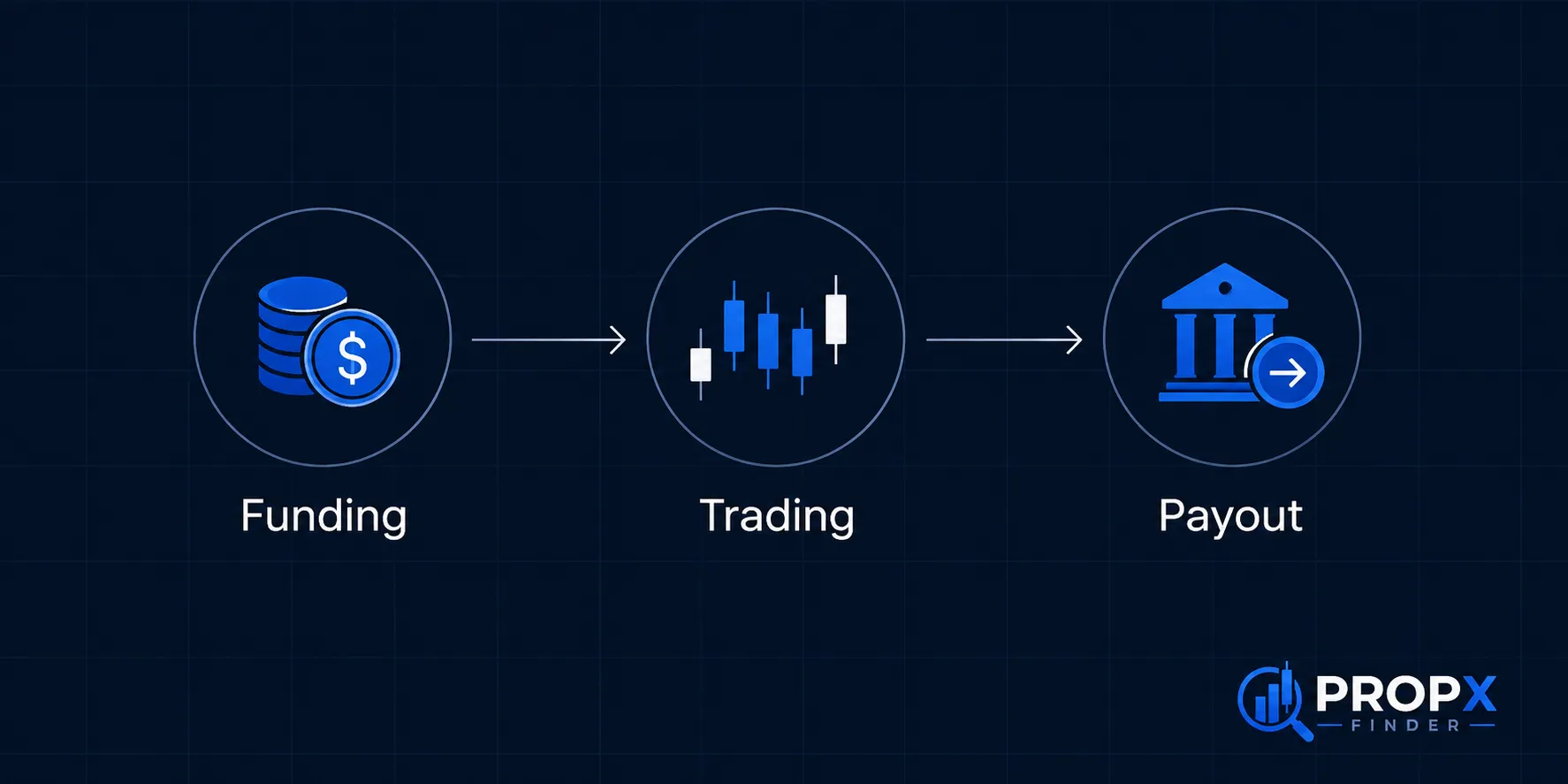
A funded trading account runs on three steps: funding, trading under firm rules, and payouts based on a profit split. You trade a simulated balance backed by the firm's capital, keep a set percentage of what you earn, and request withdrawals once you clear the firm's conditions.
If you're still fuzzy on what a funded account is, our full breakdown covers that ground. This article picks up from there: profit split math, payout conditions, and realistic timelines. We'll cover the funding-to-payout cycle, compare how different firms structure profit split, and close with a real-numbers case study.
Once you pass your evaluation, the firm moves you onto a funded account. The money isn't real yet. You're still trading a simulated balance. The firm tracks your performance and pays you based on the profit you generate, without your trades touching live markets.
This distinction trips people up. You didn't "unlock" a cash account. You unlocked eligibility for payouts, governed by the same rule structure that got you through the evaluation. For a full walkthrough of how that evaluation stage works, see our guide on prop firm challenges. What matters now is the mechanism that turns your trading performance into actual cash: profit split.
Profit split is the percentage of your net trading profit you keep, with the rest going to the firm. Most firms start traders between 80% and 90%, and some push toward 100% once you hit performance milestones.
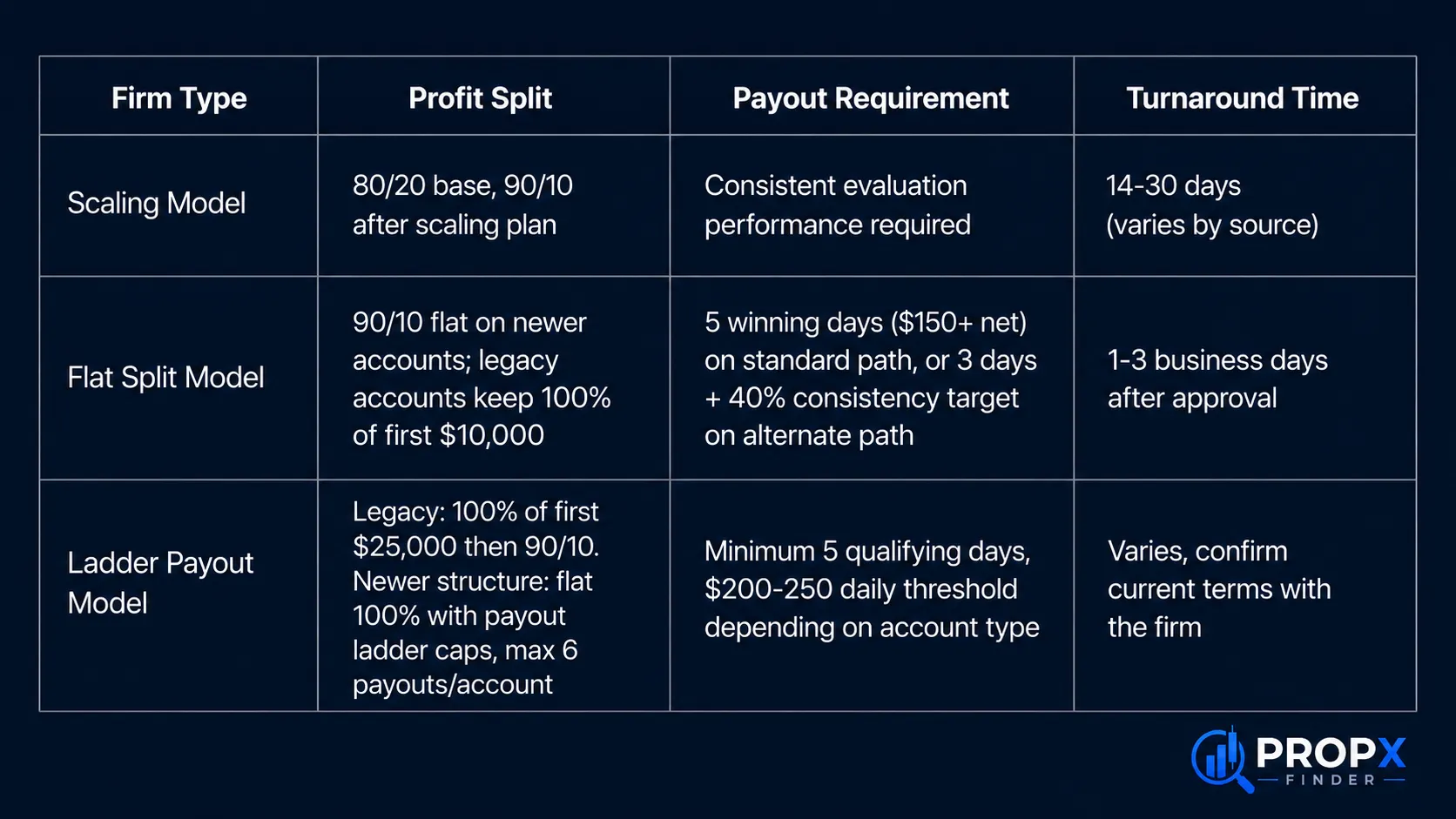
The exact split depends on the firm, and often on how long you've held the account. Some firms start funded traders at an 80/20 split. That rises to 90/10 once you qualify for a scaling plan. Others run a flat 90/10 split on newer accounts. Older, grandfathered accounts sometimes keep 100% of the first $10,000 in profit. A different structure altogether: 100% of the first $25,000 before dropping to 90/10 under a legacy model. Or a flat 100% split with payout caps built into a ladder system under a newer one.
Your eligibility for a given split often ties back to rules you already know from evaluation, including consistency requirements. Unsure how those apply post-funding? Our consistency rule guide breaks down what counts as a violation.
Firms don't let you withdraw the moment you turn a profit. You need to clear specific conditions first, usually built around consistency and time.
The most common requirement is a minimum number of "winning days": days where profit crosses a set threshold. Firms also often require a minimum number of calendar days since funding, separate from your trading activity. Some firms ask for five winning days worth at least $150 net profit under a standard path. An alternate path might need just three winning days plus a 40% consistency target. Others set a flat minimum of five qualifying trading days. The daily profit threshold runs $200 to $250, depending on account type.
These thresholds filter out lucky one-off trades from traders who show repeatable performance. A single $2,000 day on an otherwise flat account won't clear most firms' bar. Five smaller, consistent green days will.
Once you clear the conditions, you submit a payout request through the firm's dashboard. The firm reviews it, approves it, and transfers funds. Common methods include bank wire, crypto, and ACH, depending on what the firm supports and where you're located.
Turnaround time varies more than most traders expect. Industry-wide, funded traders wait 14 to 30 days for their first payout. The exact wait depends on the firm's review process and chosen payment method. Some firms move much faster. Their approval-to-transfer window can run just 1 to 3 business days once a request clears review. Fees differ by method and firm. Check your specific firm's payout page before you request, since this varies too much to generalize here.
Take a trader who passes a $50,000 evaluation and starts trading a funded account under an 80/20 split. In their first month, they generate $2,000 in net profit across a mix of winning and losing days.
To qualify for a payout, they need five winning days with at least $150 net profit each. They clear that bar in their third week, spread across days with modest, disciplined gains rather than one outsized trade. Once the firm confirms they've also met the minimum days-since-funding requirement, they submit a payout request.
At an 80/20 split, $2,000 in profit means $1,600 lands in the trader's pocket. The firm keeps $400. A trader who'd already hit the 90/10 scaling threshold would net $1,800 instead on that same $2,000. The gap between splits widens once you're pulling profit month over month, not just on the first payout.
Ready to compare firms side by side before you commit? Explore PropX Finder to see profit splits, payout terms, and entry costs across the market in one place.