
A futures prop firm funds you to trade contracts listed on a regulated exchange like the CME. A forex/CFD prop firm funds you to trade currency pairs or contracts-for-difference through a broker's own price feed.
Both models follow the same basic shape. You pass an evaluation, trade a funded account, and keep a share of the profit. The real differences show up in what you trade, what it costs, and where you're allowed to trade from.
If you've already read what a prop firm is, you know the basic mechanics. This guide picks up from there. It covers the practical differences between the two categories, then ends with a simple framework for choosing.
Futures prop firms trade standardized contracts on centralized exchanges. Forex/CFD prop firms trade currency pairs and CFDs through decentralized, broker-mediated markets. That one distinction drives almost every other difference between the two categories.
Take a contract like E-mini S&P 500 (ES) or Micro E-mini Nasdaq (MNQ). Both trade on the CME. Every trader sees the same order book. Everyone sees the same bids and offers at the same exchange-set price. Your counterparty is another market participant, matched through the exchange's central clearing system.
Forex and CFD trades work differently. You trade against your broker's quoted price. That price comes from a network of liquidity providers, not one public order book. Two traders at two different prop firms can see two different EUR/USD quotes at the same moment. Futures traders talk about "the market price." Forex/CFD traders talk about "my broker's price" instead.
The vocabulary splits along the same lines. Futures accounts reference contract specs, tick values, and margin per contract. Forex/CFD accounts reference lot sizes, pip values, and leverage ratios. Neither vocabulary is harder to learn. But mixing the two up while comparing firm offers confuses a lot of traders new to prop trading.
Regulation follows the same pattern. Futures exchanges operate under CFTC oversight in the U.S. The exchange itself sets standardized contract terms, not any individual broker or prop firm. Forex/CFD pricing and execution rules vary by broker instead. Two prop firms offering "the same" currency pair can run different spread policies and different slippage handling. Rules around news-event trading differ too. Reading a firm's execution policy matters more in the forex/CFD world. No single exchange enforces a common standard there.
Futures firms typically charge a flat commission per contract. Forex/CFD firms typically build cost into the spread, sometimes with an added per-lot commission. Both models can be fair. The real difference is how easily you can see the number you're paying.
Take a standard E-mini contract like ES. All-in round-turn commissions from prop-firm-friendly platforms commonly run $4 to $6 per contract in 2026. That's based on published broker fee schedules. Micro contracts like MES or MNQ cost less, often $1.80 to $2.50 round-turn. The smaller contract size scales the fee down with it. You see this number before you place the trade. It doesn't move with market conditions.
Forex/CFD costs work differently. On a raw or ECN-style account, EUR/USD spreads average 0.1 to 0.3 pips during liquid hours. Add a commission of roughly $3.50 to $7 per standard lot round-turn, based on 2026 broker rate cards. The spread widens during low-liquidity periods and around news events. Your actual cost per trade isn't fixed the way a futures commission is. A scalper trading during off-peak hours can pay several times the advertised spread without changing anything about their strategy.
This gap matters most for high-frequency traders. Someone placing 50 round-turns a day on ES pays a predictable $250 in commission. That number holds no matter how volatile the session gets. The same volume on EUR/USD costs a number that swings with conditions instead. Spread cost tracks trade frequency and the liquidity available at the moment of execution.
Futures markets also publish a visible order book, called the DOM or Depth of Market. It shows live bids and offers at each price level. Forex/CFD traders don't get this. You see your broker's quote, not the full liquidity picture behind it. This is a real gap in pricing transparency, not a knock against forex brokers.
Overnight costs add one more layer. Forex/CFD positions held past the daily rollover typically pick up a swap charge or credit. That number comes from the interest rate gap between the two currencies in the pair. Futures contracts don't carry a swap fee in the same sense. The cost of holding a futures position is already priced into the contract, through its expiration date. A day trader who closes every position before the session ends won't feel this. A swing trader holding for days will. Check a firm's swap schedule before committing to longer holds on a forex/CFD account.
Drawdown rules, daily limits, and geographic access all diverge between the two categories. These differences shape who can realistically use each one.
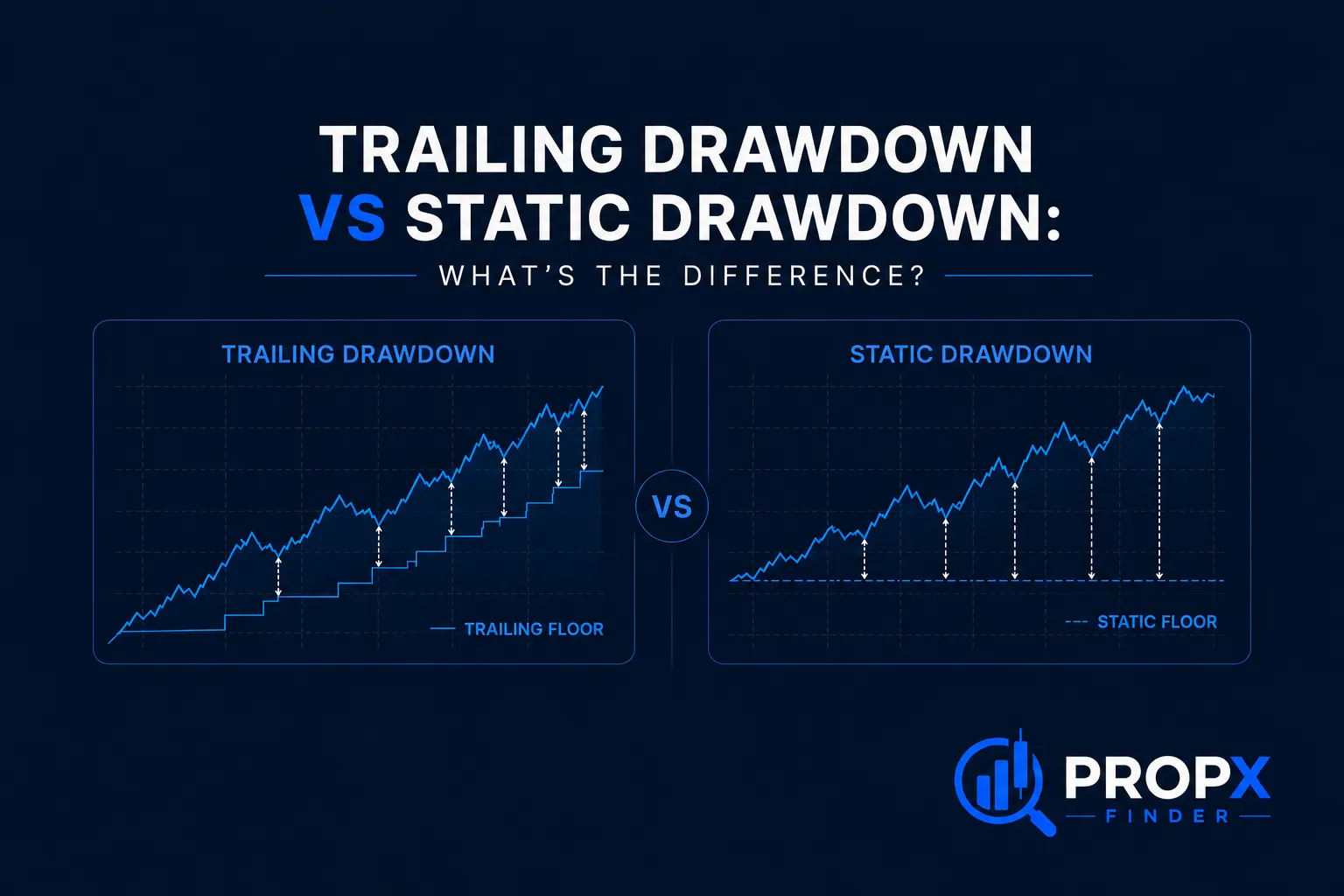
Futures prop firms in the U.S. often use trailing drawdown calculated on unrealized gains. That behaves differently from the static or trailing rules common at forex/CFD firms. If you're weighing rule types, the mechanics matter more than the label. Our breakdown of trailing drawdown vs. static drawdown covers how each one plays out during a losing streak.
Geographic access is where the categories split hardest. Many forex/CFD prop firms restrict or exclude U.S.-based traders. That's a consequence of how CFDs get regulated in the United States. Futures prop firms face no such restriction, since futures contracts trade on a regulated U.S. exchange. If you live in the U.S., this alone can decide which category is even open to you.
Trading hours differ too. Futures markets linked to the CME run nearly 24 hours on weekdays, from Sunday evening through Friday afternoon Eastern time. There's a short daily maintenance break. Forex trades around the clock across global sessions like Asia, London, and New York, with no exchange-mandated pause. Liquidity does thin outside the major session overlaps.
Consistency rules show up at firms in both categories. They require you to spread your profit across multiple trading days, instead of earning it all in one session. Neither asset class is stricter here on its own. What varies is firm-by-firm policy. Check the specific evaluation rules rather than assuming a pattern based on category.
Margin requirements diverge too, and this shapes how much capital a trade actually ties up. A standard futures contract like ES typically requires several hundred to over a thousand dollars in day-trading margin. The exchange sets that number and adjusts it for volatility. Micro contracts scale it down to roughly $50-100 per contract. Forex/CFD accounts work off leverage ratios instead, often 30:1 to 100:1 depending on the broker and jurisdiction. That ratio changes how much account balance a given position size consumes. Neither structure wins on its own. They just measure risk differently. Comparing "margin" on a futures firm to "leverage" on a forex/CFD firm isn't a like-for-like comparison. Convert the numbers yourself first.
For the mechanics of how an evaluation gets judged, pass or fail, see how the prop firm challenge works.
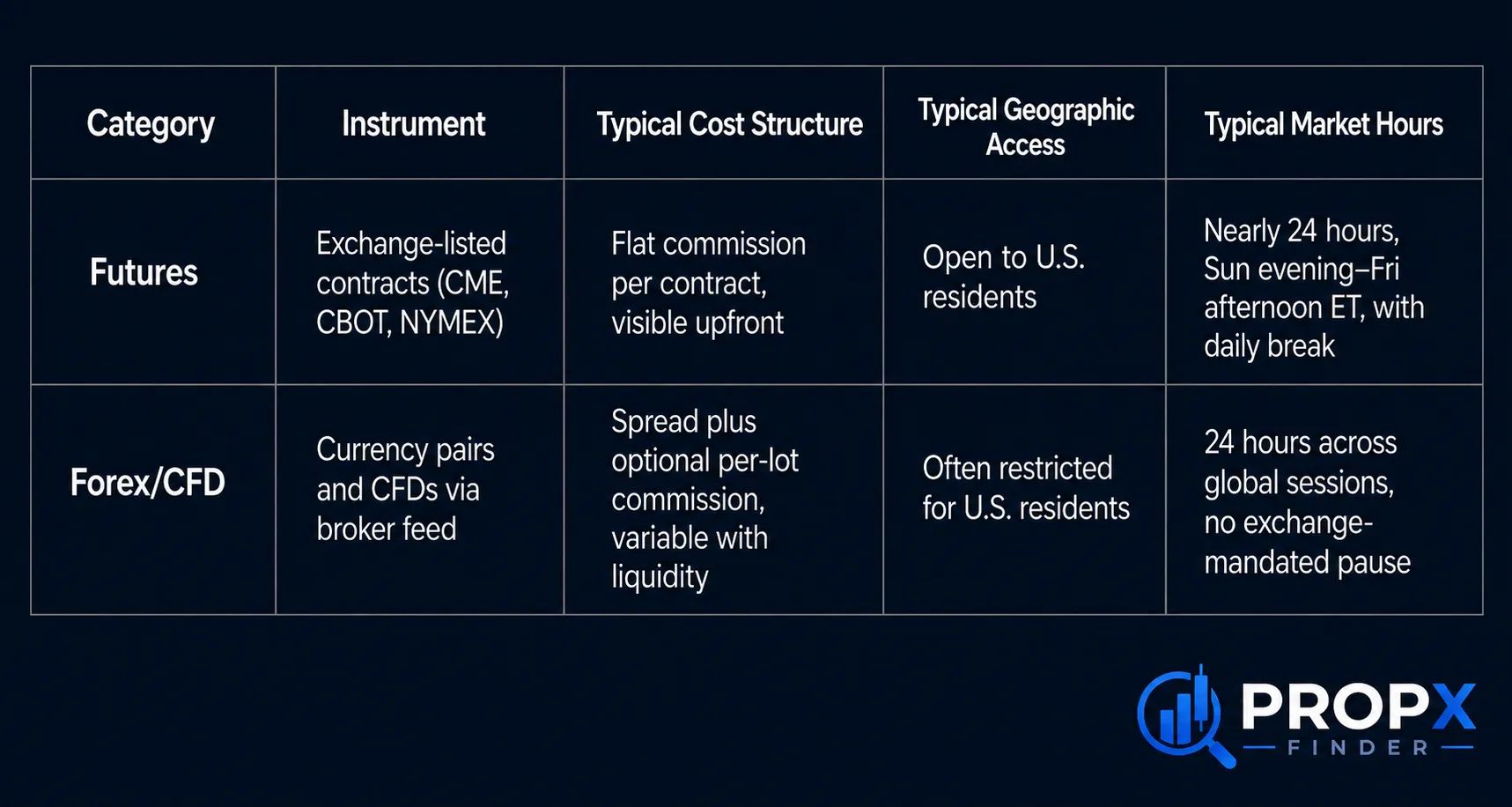
The table below lines up both categories side by side. It covers instrument, typical cost structure, typical geographic access, and typical market hours.
Picture two traders facing the same prop firm decision from different starting points.
The first trades 30 to 40 times a day, holding positions for minutes. Execution cost makes or breaks her results. She works a full-time job and trades in three fixed windows: before market open, lunch, and evening. A fixed $2 micro-contract commission beats a spread that might triple during a news spike. The CME's near-24-hour schedule also means she can trade her evening window without waiting on a specific session. She picks a futures firm and trades MNQ. She can calculate her exact cost per trade before the market even opens.
The second holds positions for hours or days and checks in two or three times per session. He values predictable weekend and evening access over rock-bottom per-trade cost. He lives outside the U.S. and trades a swing strategy on EUR/USD and GBP/USD, rarely placing more than four or five trades a week. Spread variability barely touches him at that frequency. The geographic restrictions that would block a U.S.-based trader don't apply to him either. He picks a forex/CFD firm. Round-the-clock access across multiple pairs matters more to his schedule than the fixed-commission structure a scalper needs.
Neither choice wins in the abstract. The right one depends on how often you trade and how much spread variability affects your strategy. It also depends on whether forex/CFD prop firms are even open to you.
Choose a futures prop firm if you trade often, want a fixed and predictable cost per trade, need full order book visibility, or live in the U.S. and want to sidestep geographic restrictions.
Choose a forex/CFD prop firm if you trade less often or hold positions longer. It also fits if you want access to a wide range of currency pairs and CFD instruments. Your country needs to be off the restricted list too.
Some traders use both. Running a futures evaluation alongside a forex/CFD account spreads out strategy and cost exposure. A funded futures account doesn't stop you from also holding a funded forex account elsewhere. Each evaluation runs on its own.
Before you commit an evaluation fee to either category, pull up the specific firm's rulebook. Don't rely on general assumptions about futures or forex/CFD as a category. Drawdown type, consistency rules, and permitted trading hours vary firm by firm. Sometimes they vary as much within a category as between the two. The instrument you trade sets the broad cost and access picture above. The individual firm's rules decide whether you pass the evaluation and get paid.

.webp)