
The consistency rule caps how much of your total profit can come from a single trading day, usually 20-50% depending on the firm. It doesn't fail your account. It blocks your payout until your profit spread flattens out.
Traders panic when they see the term in a rejection email, but the fix is math, not damage control.
This article walks through the definition, the exact formula firms use, a worked example with real numbers, what happens when you trip the rule, and how thresholds shift between firms. FAQ at the end covers the questions that come up most.
The consistency rule limits the share of your total profit that one trading day can represent. If a firm sets the threshold at 30%, no single day can account for more than 30% of your cumulative gains when you request a payout.
Picture your profit as a pie chart. The consistency rule says no single slice can dominate the chart. Firms want your total profit to come from a spread of trading days, not one outlier session that skews the whole picture.
A trader who nails one massive day and then coasts hasn't proven a repeatable process. You could have caught a lucky move, oversized a position, or ridden a single news spike. Firms pay funded traders based on skill they can rely on across future months, not a single session that might never repeat. The rule filters for consistency because consistency is what a firm can underwrite.
Coverage varies. Some firms apply the consistency rule only during the evaluation phase and drop it once you're funded. Others carry it through to every funded payout request. A smaller group skips the rule entirely and relies on other risk controls instead. Check your specific firm's rulebook before you assume either way. The variance here is wide enough that guessing costs you a delayed payout.
You calculate the consistency rule with one formula: Best Day Profit ÷ Consistency Percentage = Required Total Profit. Hit that total and your best day stops being a violation.
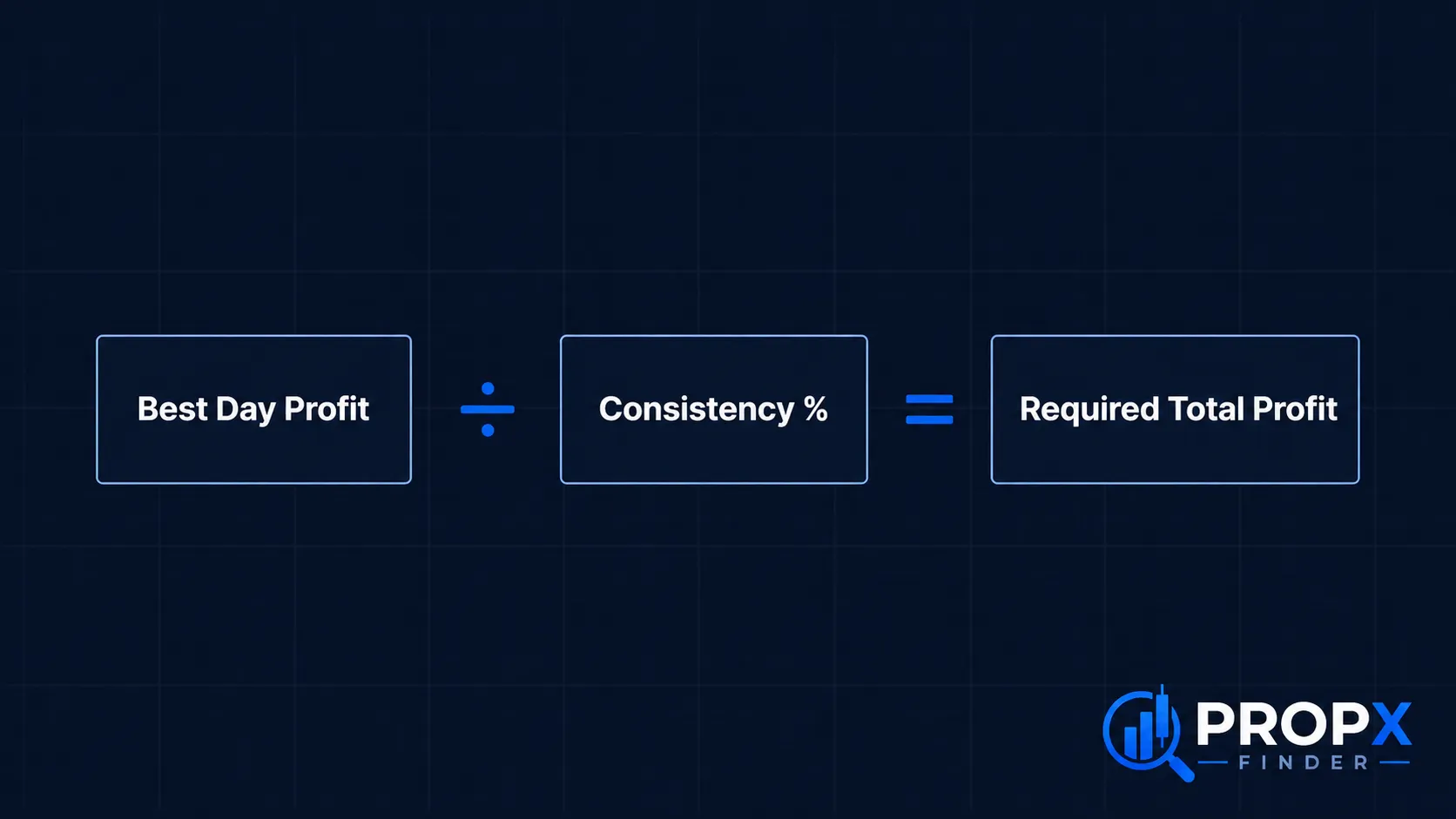
Take your single best trading day (by profit) and divide it by the firm's consistency percentage. The result is the minimum total profit you need across your entire trading history for that best day to fall within the allowed share.
Best Day Profit ÷ Consistency % = Required Total Profit
If your best day made you money, this number tells you the floor. Fall short of it and your best day represents too large a slice of your total.
Topstep runs this exact scenario in its own documentation. A trader's best single day nets $1,200. Topstep's consistency threshold sits around 43% in this case. Run the formula: $1,200 ÷ 0.43 = roughly $2,800 in required total profit. That trader needs $2,800 across all trading days combined before that $1,200 day stops looking disproportionate.
Tradeify runs three separate thresholds depending on account type: 20% for Lightning Funded accounts, 35% for Growth, and 40% for Select Evaluation. A trader on a Lightning Funded account with a $500 best day would need $2,500 in total profit ($500 ÷ 0.20) to clear that same test. Same trader, same best day, different account type, different math. Read your specific account terms before you calculate anything.
Losing days don't cancel out your best day's share. They increase it. Consistency percentage measures your best day against your net total profit, and every red day drags that total down. A string of losses after a strong day shrinks your denominator, which pushes your best day's percentage higher, not lower. Traders who assume a few bad days will "balance things out" have the mechanics backward. The fix is more profitable days, not fewer losing ones.
Breaking the consistency rule holds your payout. It doesn't touch your account status, your balance, or your evaluation progress. A drawdown breach can end your account outright. The two violations sit in completely different categories, and firms design them that way on purpose.
A consistency rule violation is a proportion problem, not a risk problem. Your account stays open. Your trading continues. You can't withdraw yet, because your profit distribution doesn't match what the firm requires for payout eligibility. Once your total profit grows enough that your best day falls back under the threshold, the block lifts and you request payout as normal. Some firms also let you avoid this: instead of building unrelated profit, you get flagged during the trading challenge phase itself, before you ever reach a funded account, so you can adjust your trading spread with no money at stake yet.
Consistency rule thresholds run from 20% to 50% across the industry, and a meaningful number of firms don't enforce the rule at all. There's no universal standard here, which means the number that matters is the one written into your specific firm's rules, not an industry average.
Firms set tighter thresholds (around 20%) when they want stricter proof of repeatable trading across many sessions. Looser thresholds (closer to 50%) give traders more room for one strong day to carry a larger share of total profit. Tradeify's own tiered structure shows this in miniature: 20% on one account type, 40% on another, inside a single firm's product line. The threshold isn't a fixed industry number. It's a lever each firm pulls based on how it wants to underwrite risk.
Read the specific consistency rule terms before you purchase an evaluation, not after you hit a payout wall. Two firms can offer near-identical profit targets and drawdown limits while running completely different consistency thresholds. That difference decides whether your trading style clears payout on the first try or stalls for weeks. This isn't a case of picking the "best" firm. It's matching a firm's threshold to how your own trading naturally distributes profit across days.
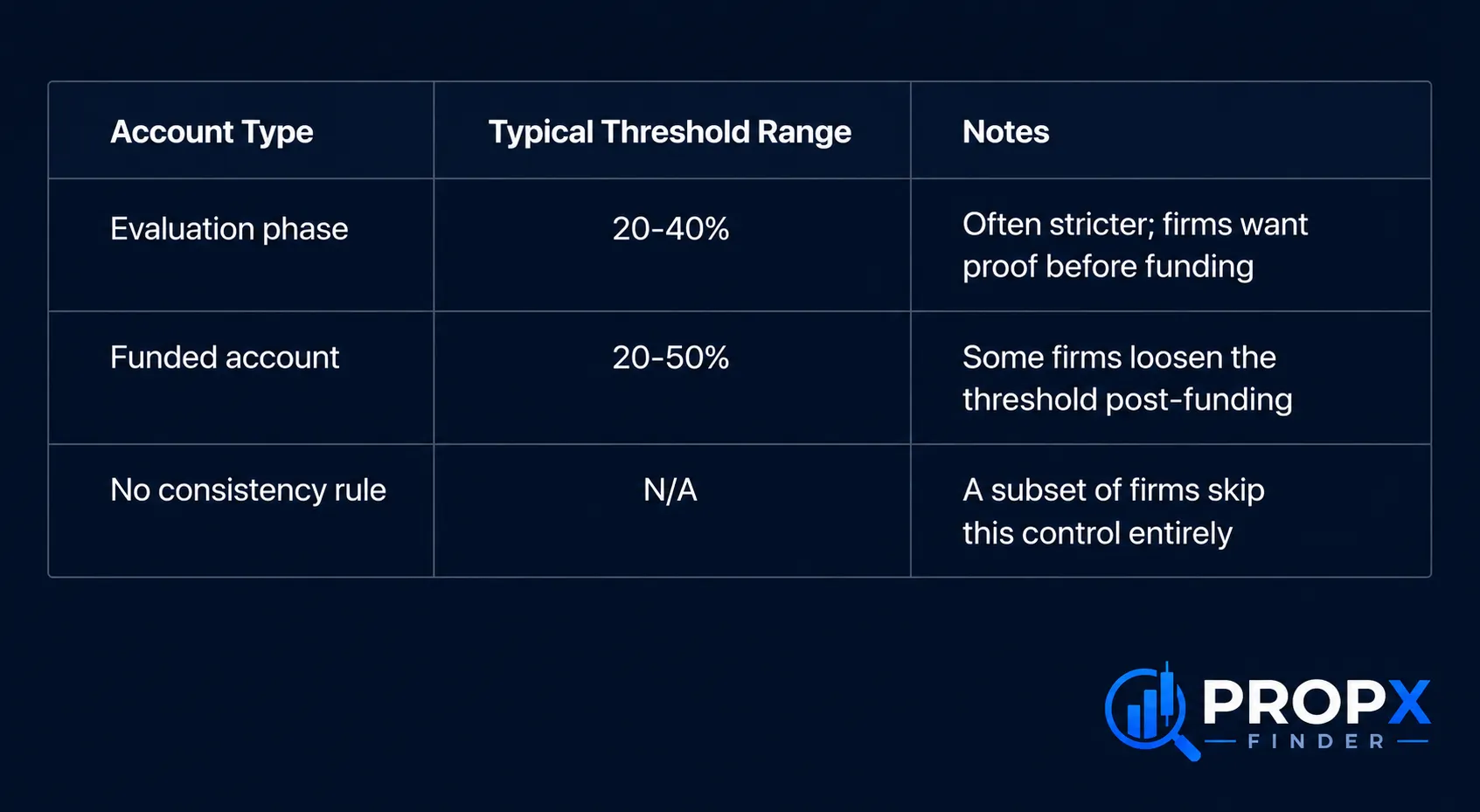
Ranges reflect terms observed across the industry as of August 2026. Confirm exact figures with your specific firm before relying on any number here.
A trader spent six weeks clearing a funded evaluation with a clean, steady approach: small daily gains, tight risk, no single day standing out. Then a major economic data release hit mid-week. The trader caught the move early, sized the position well, and closed the day up $3,000, more than double any other session in the entire evaluation.
Total profit across the full evaluation period sat at $6,200. That $3,000 day represented roughly 48% of the total. The firm's consistency threshold was set at 30%. The trader hit the profit target. The drawdown limit never came close to breaching. And the payout request still came back blocked.
Nothing about the trading was wrong. The math hadn't caught up yet. The fix wasn't a new strategy or tighter risk management. It was time. The trader kept the same approach running for another two weeks, added roughly $4,000 in additional profit spread across multiple days, and pushed total profit past $10,000. That $3,000 day now sat at 30% of the new total. Payout cleared on the next request.
The lesson isn't about caution around big trading days. It's about understanding that one outsized session, however earned, needs a matching base of profit around it before a firm will release funds. That's proportion math, not a penalty.
Ready to see how consistency requirements stack up against everything else a firm asks of you? Compare prop firm rules side by side and check profit targets, drawdown limits, and payout terms in one place.



.webp)