
A funded trading account is a trading account backed by a proprietary trading firm's capital, granted to you after you pass an evaluation proving you can trade profitably within set risk limits. In exchange for trading the firm's money, you keep an agreed share of the profits you generate.
Trading with someone else's capital instead of your own can sound almost too good to be true - which is exactly why so many new traders hesitate before applying, unsure whether the concept is a scam or something reserved only for professionals. It's neither: it's a straightforward arrangement built around proven skill, not luck.
This guide breaks down what a funded trading account actually is, how the process of getting one works, what rules govern how you trade, and how profit sharing operates. By the end, you'll understand whether this path fits your trading goals - and what to expect if you decide to pursue one.
A funded trading account is a trading account funded by a proprietary trading firm's capital rather than your own money. You're granted access after passing an evaluation that proves your trading skill and risk discipline. The firm keeps ownership of the capital; you trade it under their rules and split the profits according to an agreed percentage.
This is fundamentally different from opening an account with your own savings. Self-funded trading puts your own capital at risk - every loss comes directly out of your pocket, and every profit is entirely yours. A funded trading account shifts that capital risk to the firm. You risk your time, your evaluation fee, and your access to future funding, but not personal savings beyond what you paid to attempt the evaluation.
The core difference is capital ownership. With your own capital, you set your own rules - no daily loss limits, no drawdown caps, no firm-mandated position sizing. With a funded account, the firm imposes structured drawdown limits and trading rules designed to protect their capital. You gain access to larger sums than most retail traders could afford on their own, but you trade within a stricter framework.
Funded accounts typically attract traders who have a proven strategy but limited personal capital to scale it. This includes part-time traders looking to grow beyond what their own account allows, as well as experienced traders who want to diversify their income without risking additional personal funds. It's less suited to complete beginners still developing a strategy, since evaluations require consistent, disciplined performance from day one.
Getting a funded account requires passing a structured prop firm evaluation that tests whether you can trade profitably while respecting strict risk limits. The process typically unfolds over one or two phases before you gain access to real funded capital - it isn't instant, and firms design it that way on purpose.
You start by purchasing access to an evaluation, often called a trading challenge. The firm sets a profit target you need to hit within a defined timeframe, while staying under specific loss limits. This phase tests consistency, not luck - firms want to see that your gains come from a repeatable process, not a single lucky trade.
Many firms use a two-step model. After passing the first evaluation phase, you move into a verification phase with a similar - sometimes slightly relaxed - profit target. This second phase confirms your first-phase performance wasn't an outlier. Not every firm requires this step; some move straight from evaluation to funding.
There are two broad approaches. Challenge-based funding requires you to pass one or more evaluation phases before receiving a funded account. Instant funding models skip the evaluation and grant access to a funded account immediately, typically in exchange for a higher fee and often with more conservative profit splits or stricter early-stage rules. Each model trades speed for cost and risk differently, so the right choice depends on how confident you are in your strategy before paying for access.
One detail that surprises a lot of traders: in either model, the funded account you receive is typically a simulated account, not a live brokerage account placing real market orders. You're still paid as if you were trading real capital - the firm covers payouts either from the pool of fees collected across all evaluation attempts, or by mirroring your trades onto its own live capital. Genuine live-money accounts are usually reserved for traders who've built a longer track record of consistent, funded performance.
Funded accounts are governed by strict risk rules - daily loss limits, drawdown caps, and position-size restrictions — all designed to protect the firm's capital. Understanding them before you start trading is essential: breaking these limits, even accidentally, typically ends your access to the account.
It's worth understanding why these rules are so strict in the first place: evaluation fees make up a meaningful share of how prop firms generate revenue, and evaluation rules are built to make passing genuinely difficult - not just a formality. Industry-wide, only about 5-10% of evaluation attempts succeed, according to data compiled by QuantVPS, though some firms report notably higher pass rates; Apex Trader Funding, for example, cites 15-20%. That's not a reason to distrust the model - it's simply the mechanism that keeps it commercially viable - but it does mean every rule below is worth treating as non-negotiable rather than something to work around.
A daily loss limit caps how much your account can lose in a single trading day, usually expressed as a percentage of your starting balance. Hit that limit, and trading is paused or the account is closed, depending on the firm's policy. This rule exists to prevent a single bad day from wiping out the account.
Total drawdown limits the maximum loss allowed from your starting balance over the life of the account. Some firms use a trailing drawdown, where the limit moves upward as your account grows, locking in some of your gains as a floor. Trailing drawdown rules require closer monitoring, since the "safe" loss margin shrinks as you profit.
Firms also restrict how large a position you can open, the leverage available to you, and sometimes whether you can trade during major news events, when volatility spikes unpredictably. These rules vary significantly between firms, so reading the specific terms before starting an evaluation matters more than assuming standard limits apply.
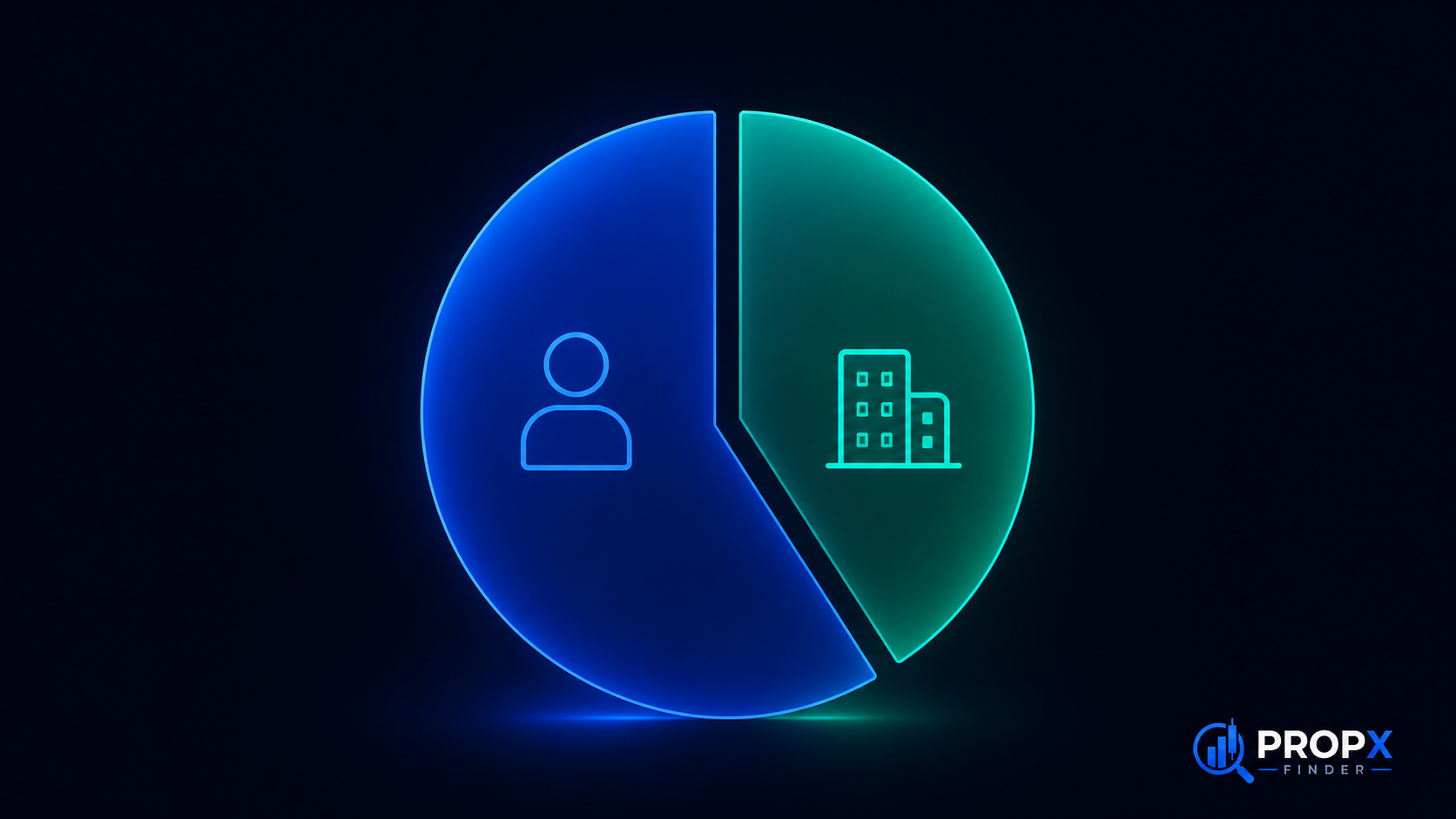
Profit split is the percentage of trading profits you keep once you're funded, with the remainder retained by the firm - it's the entire reason funded accounts exist as a business model.
Once you're funded and generate profit, that profit is divided between you and the firm according to a pre-agreed percentage. Splits vary by firm and sometimes scale upward the longer you trade profitably and consistently. FTMO, one of the industry's most recognized brands, illustrates this well: its two-phase evaluation model starts traders at an 80% profit split that scales up to 90% with consistent performance, according to data compiled by TradeZella.
Payout frequency and profit split structures differ across the industry. The table below shows examples from several firms to illustrate the range you'll encounter.
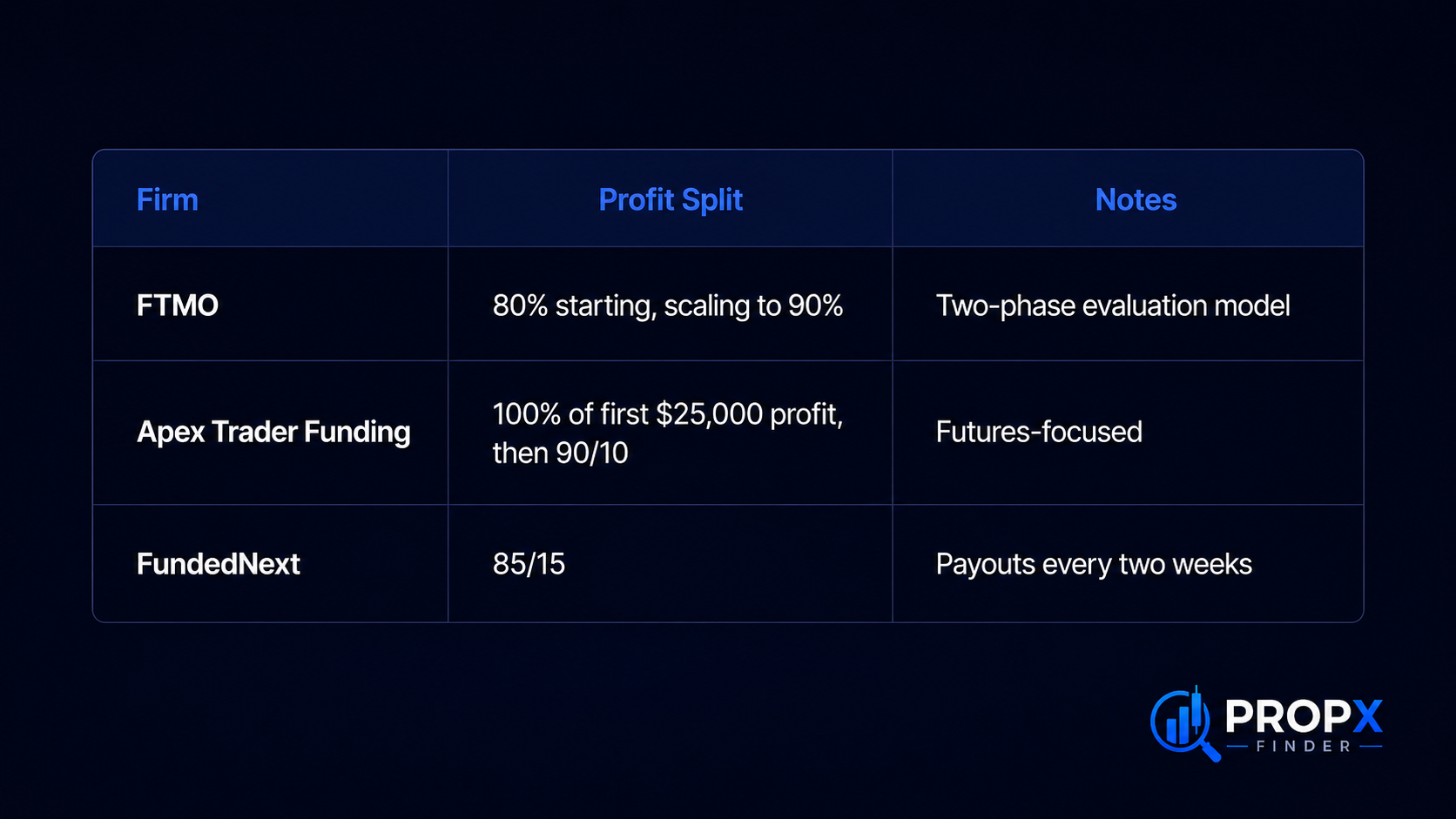
Across the industry, a profit split starting around 80% has become a common baseline for 2026. Offers advertising 100% splits are worth reading carefully - they often require six or more months of consistent performance before that rate applies.
Note: these figures come from third-party industry sources and are provided for general context. Confirm current terms directly with any firm before applying.
Consider a trader starting a two-phase evaluation on a $50,000–$100,000 account. Their goal in phase one is to hit a defined profit target without breaching the daily loss limit or total drawdown cap, typically within a 30-day window.
The trader identifies a strategy that fits their risk limits, tracks each trade's impact on their drawdown, and reaches the phase-one target without triggering a breach. In phase two, they trade the same size and strategy at a slightly relaxed target, confirming their earlier results weren't a fluke.
Once funded, the trader begins live trading with the firm's capital. Their first profitable trading cycle generates a payout under the account's profit split terms, credited according to the firm's payout schedule. The lesson here isn't the size of the payout - it's that consistency and strict rule adherence, not aggressive risk-taking, are what get traders through the evaluation and into a live payout cycle.
If you're weighing whether this path fits your trading goals, our mission at PropX Finder is to help you compare firms with clarity, not hype. You can also head back to the homepage to explore what's coming next.



.webp)