
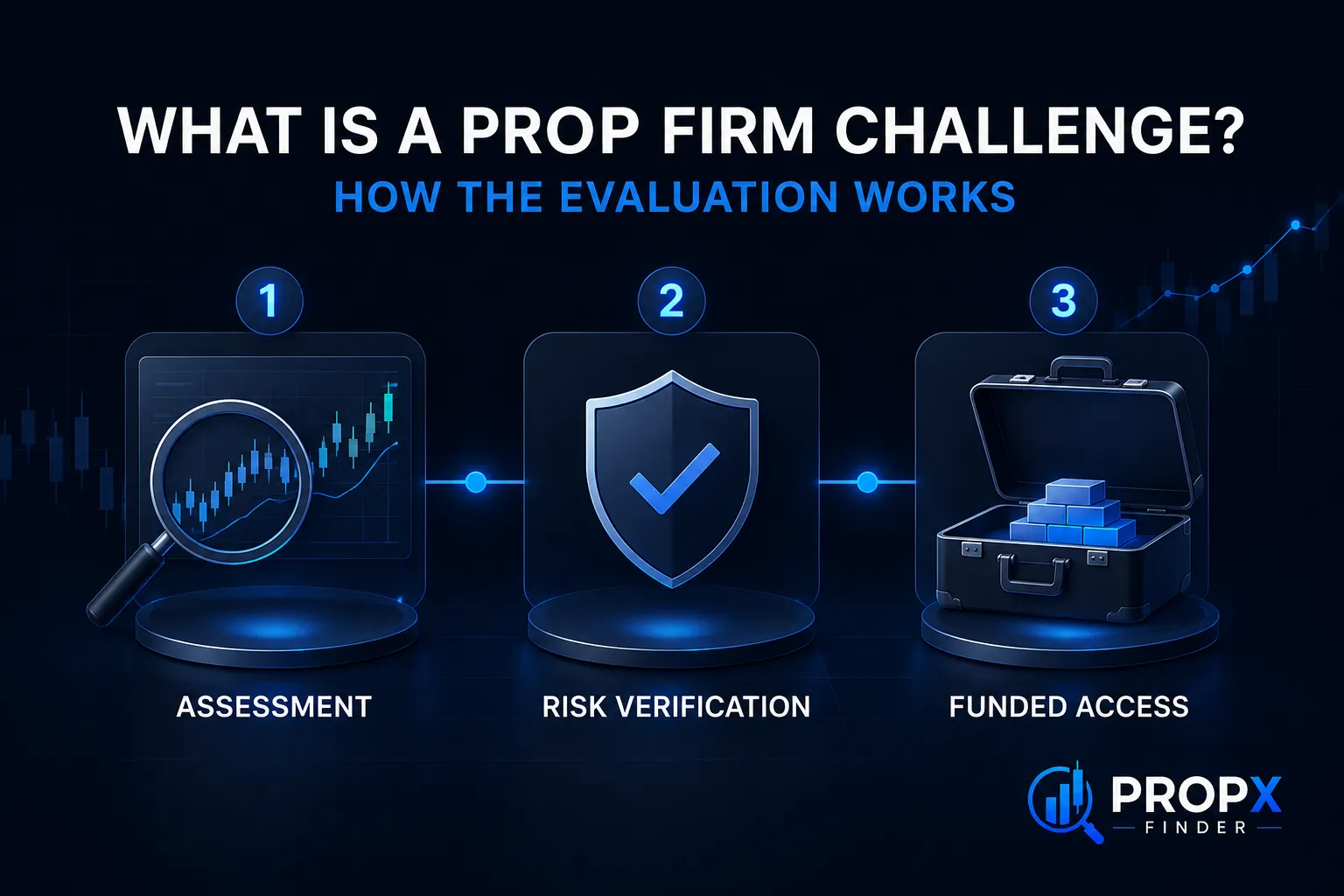
A prop firm challenge is a paid evaluation that tests whether you can trade profitably within a firm's risk rules, before it hands you a funded account. You pass by hitting a profit target while staying inside drawdown limits over one or more phases.
Once you clear the evaluation, the firm gives you access to its capital and you keep a share of the profits you generate.
If you've read our guide on what a prop firm is, you already know the basic setup: a firm gives you money to trade, you keep part of the profit. The challenge is the gate you walk through to get there. Firms advertise 1-step, 2-step, and instant funding options, then layer different drawdown types (static, trailing, EOD) on top. Two firms can both call their product a "2-step challenge" and mean structurally different things.
This guide covers how phases work, how the four drawdown types differ, and what the consistency rule restricts. It also covers something most guides skip: how the market you trade (forex, futures, or crypto) shapes which structure you're likely to encounter.
A prop firm challenge is a simulated or live trading test a proprietary trading firm uses to verify you can manage risk and generate profit before risking its own capital on you.
Think of it as a job interview conducted through your trading account. The firm sets the rules: a profit target, a maximum drawdown, sometimes a minimum number of trading days. You trade a demo or live account under those constraints. Clear them, and you move on to a funded account. Break a rule, and the evaluation ends.
Firms run challenges because verifying skill through a controlled test costs less than losing capital on an unproven trader. For you, the challenge fee (typically $50 to a few hundred dollars, depending on account size) buys a shot at trading with capital you don't have to raise yourself.
The three common phase structures are 1-step (single evaluation), 2-step (two sequential evaluations), and instant funding (no evaluation phase at all). None of them is easier than the others by default. Phase count and evaluation difficulty are separate questions.
2-step challenges split the evaluation into two phases. Phase 1 typically requires roughly 8-10% profit (sometimes as low as 5%). Phase 2, often labeled "verification," usually drops to around 5%. You must clear both before funding.
1-step challenges compress the process into a single phase, but that phase carries a higher profit target to compensate, typically 10-12%. Some firms structure it as one stage at 11%, others at 12%. You prove the same amount of skill, in one pass instead of two.
Instant funding skips the evaluation phase entirely. You get live capital immediately, usually with tighter risk limits and a lower initial profit split until you build a track record.
A 1-step challenge with a static drawdown limit can be harder to pass than a 2-step challenge with a looser, per-phase structure. Phase count tells you how many hurdles you clear. It says nothing about how tight the risk rules are inside each hurdle. Drawdown type determines difficulty, and it's a separate variable from phase count.
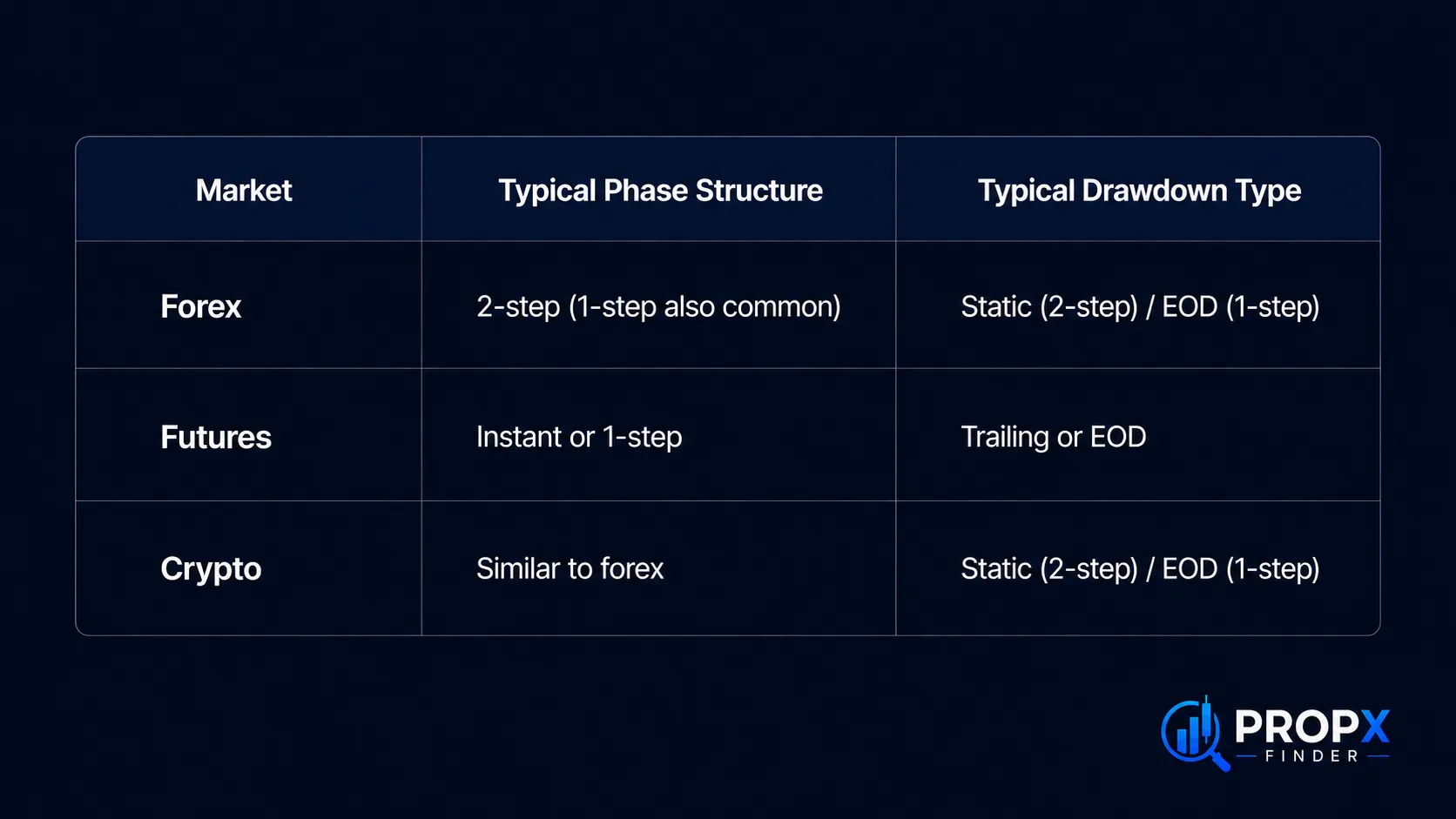
The market you trade shapes which challenge structure you're likely to see. Drawdown mechanics interact with each asset class's trading hours and volatility profile in different ways, and firms build their evaluation rules around those differences.
Forex challenges lean toward 2-step structures, though 1-step options exist too. In the 2-step version, static drawdown dominates: your maximum loss limit is fixed from day one and never moves. In the 1-step version, end-of-day (EOD) drawdown shows up more often, where your limit resets based on your balance at the close of each trading day rather than staying fixed.
Futures challenges skew toward instant funding or single-phase evaluations, and the dominant drawdown types are instant or 1-step trailing models tied closely to your live account balance. Futures markets trade on exchange hours with defined settlement, which supports tighter, faster-moving risk structures than a multi-week forex evaluation.
Crypto challenges follow patterns similar to forex: comparable phase structures, comparable drawdown types. One structural difference sets them apart. Crypto markets trade 24/7. There's no market close, no weekend gap, no session boundary. That changes how EOD-style drawdown gets calculated, since "end of day" needs a defined cutoff even when the market never technically closes. Your account also stays exposed to price movement around the clock, including hours when you're not watching a screen.
Drawdown is the maximum amount your account can lose before the evaluation fails, and how that limit is calculated is a separate decision from how many phases you face.
Static drawdown sets your loss limit once, based on your starting balance, and never moves it again. A $5,000 account with a 10% max static drawdown fails permanently at $4,500, regardless of how high your balance climbs afterward.
Trailing drawdown moves your limit up as your balance grows, then locks it once you hit your profit target. A $10,000 account with 6% max trailing drawdown starts its floor at $9,400. As your balance rises, the floor rises with it, until you reach $10,600 in closed equity, at which point the floor locks at $10,000 and stops trailing.
EOD (end-of-day) drawdown recalculates your limit based on your balance at the close of each trading day, rather than tracking every tick intraday. It gives you more room to ride out volatility within a single session, since only your day-end balance counts against the limit.
None of these three types is tied to a specific phase count. A firm can pair static drawdown with a 1-step challenge or a 2-step one. Check both variables separately when you compare offers.
The consistency rule caps how much of your total profit can come from a single day, calculated as (best day's profit ÷ total profit) × 100. Firms set the threshold anywhere from 20% to 50%, most commonly 25-40%.
Say you've earned $4,000 in total profit during your evaluation, and your firm sets a 30% consistency rule. No single day's profit can exceed $1,200, or 30% of that $4,000 total. If one lucky trade nets you $1,500 in a day and the rest of your profit adds up to $2,500, you've broken the rule even though your account is still profitable.
Violating the consistency rule typically doesn't fail your account. It pauses your payout until your profit distribution meets the threshold. You keep trading, keep your funded status, and the firm withholds the withdrawal until your day-to-day profit spread evens out. Most traders read this rule as a pass/fail line and panic the first time they trip it. Treat it as a payout gate instead, and you'll skip the overtrading that people use to try to "fix" a rule that was never going to end their account.
A trader named Marcus wanted to fund a forex account and had two offers in front of him. Offer A: a 1-step challenge with EOD drawdown, 11% profit target. Offer B: a 2-step challenge with static drawdown, 8% Phase 1 target, 5% Phase 2 target.
Marcus scalps intraday, closing every position before the session ends. EOD drawdown, which only checks his balance at day's close, gave him more room to absorb intraday swings without tripping a limit mid-trade. He picked Offer A.
Three weeks in, a volatile news day pushed his floating loss past what a static drawdown would have allowed, but his end-of-day balance stayed inside the limit because he'd closed out before the close. He passed on his first attempt.
A swing trader who holds positions overnight would have found EOD drawdown riskier, since unrealized losses can build across days before the day-end check catches them. Marcus's result came from matching drawdown type to his own trading style, not from EOD being the stronger choice in general.
Read our companion guide on what happens after you pass to see how funded accounts, profit splits, and payout terms work once your challenge is behind you. And when you're ready to compare specific offers side by side, head to PropX Finder to see what's available.



.webp)