
A crypto prop firm gives you a funded account for crypto trading after you pass an evaluation. You keep a share of the profit.
The balance on that account is often simulated, so you may never trade real coins.
Crypto prop firms also run on 24/7 markets and use rules that a forex account does not have. Leverage, loss limits and stablecoin payouts shape every decision you make on these accounts. New to the model? Read how prop firms work first.
Below you find the evaluation model and the rules specific to crypto. You also get the payout and cost details. A checklist of risks closes the article. Use it before you buy a crypto prop firm challenge.
A crypto prop firm funds traders on crypto markets in exchange for a share of their profit. You pay a fee, pass an evaluation and then trade a funded account under the firm's rules.
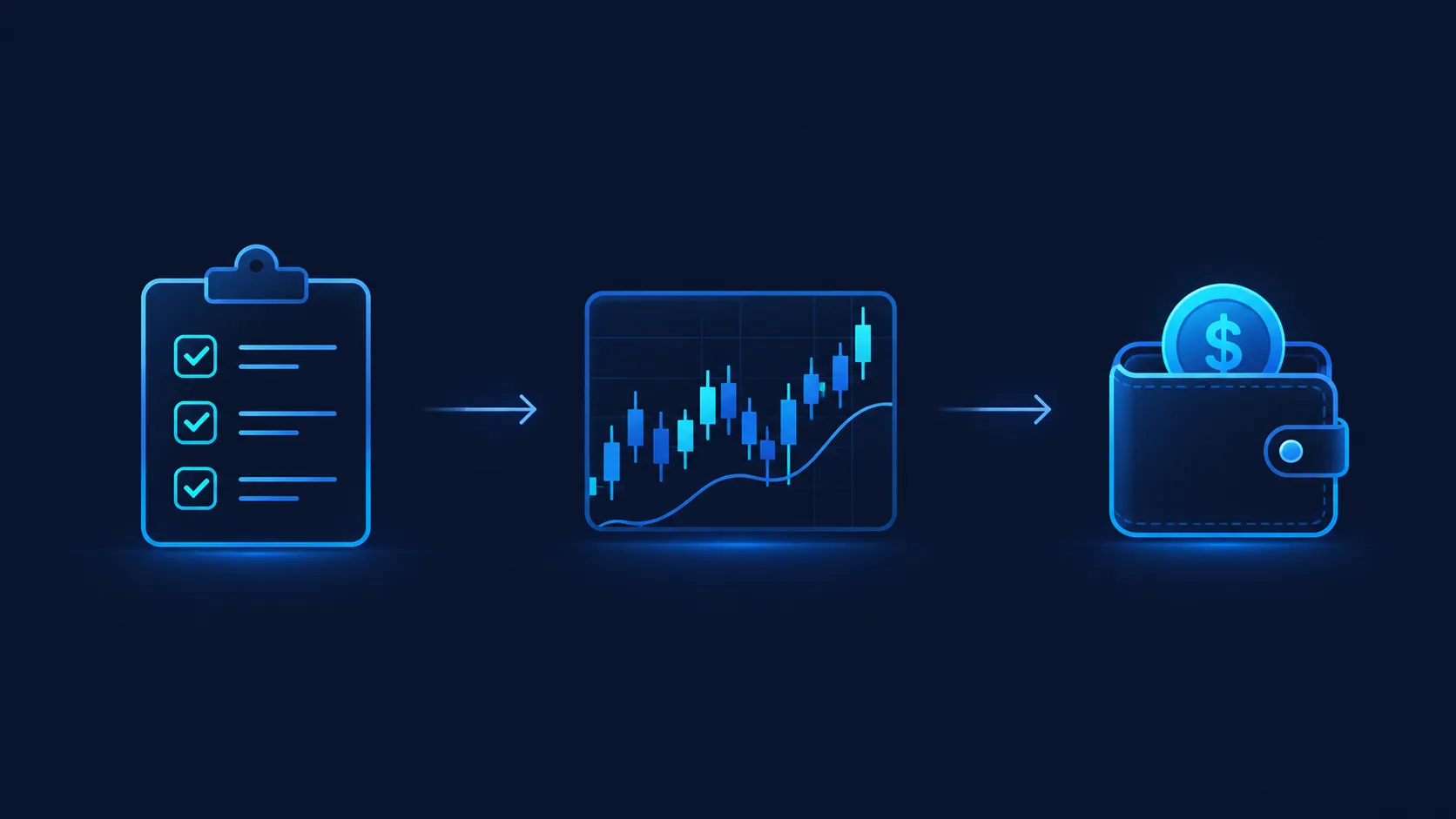
A crypto prop firm runs three stages: evaluation, funded stage and payout. Each stage has its own goals and limits.
In the evaluation, you hit a profit target without breaking the loss limits. In the funded stage, you trade under the same limits and earn a profit split. The profit split is your share of profit after the firm takes its cut. At payout, you withdraw that share.
HyroTrader shows the structure. According to its terms, the 1-Step challenge has a 10% profit target. It sets a 4% daily loss limit and a 6% maximum loss. The 2-Step challenge has a 10% target in phase one and 5% in phase two, with the same limits.
Account sizes run from 5K to 200K USDT. Each size follows the same stage order, so a larger account raises the dollar targets and the dollar limits together.
Many crypto prop firm accounts use simulated balances. CoinGecko Learn reports that balances at many crypto prop firms are simulated, with no real coins behind them. You trade real market prices, but you do not own the coins.
Some firms connect the account to an exchange through an API or a sub-account. HyroTrader links to Bybit through an API, and its evaluation and funded accounts stay simulated. Access to real capital follows consistent results and a minimum profit, about 10% in the 1-Step.
Read each firm's terms to learn which account type you get. The answer changes how you judge the offer and the risks that come with it.
Retail prop firms earn most of their revenue from evaluation fees. Weigh that model when you read the rules. Look for the page where the firm states how it funds payouts.
A forex firm that lists a few crypto pairs keeps its forex rules and its account structure. A crypto prop trading firm builds its rules around 24/7 markets, perpetual contracts and stablecoin payouts.
A crypto prop firm uses crypto terms in its rulebook, such as perpetual contracts and funding rates. A forex firm with a few crypto pairs may use forex terms instead.
Check which type of firm you are buying. For the wider split between futures and forex prop firms, read our comparison.
Crypto prop firm rules center on 24/7 trading, leverage on perpetual contracts and tight loss limits. Each firm sets its own version of these rules.
Crypto markets run 24 hours a day with no weekend break, according to thepropfirmguide.com. Some crypto prop firms close your positions before the weekend. Others let you hold them.
Read the weekend rule before you open a swing trade on Friday. A move on Sunday night counts against your limits like a move on Tuesday.
The rule also affects sleep and planning. If your firm forces a close before the weekend, you need an exit plan for Friday. If it allows holding, you need a stop-loss that works while you are away.
Leverage lets you control a position larger than your balance. A crypto prop firm sets its own leverage cap, and the cap can differ per instrument. Read the cap before you size a trade.
Perpetual contracts have no expiry date. They charge funding rates, which are periodic payments between long and short traders. Funding rates raise or lower the cost of holding a position over time.
Check whether the firm counts funding payments toward your loss limits. A position held for days can pay funding on top of any price loss.
A daily loss limit caps how much the account can lose in one day. A maximum loss limit caps the total loss from your starting balance. The daily limit resets each day, and the maximum limit applies to the whole account.
HyroTrader sets 4% and 6% for these two limits. One aggregator lists a 3% loss limit on a single trade at the same firm. Confirm that figure in the rules. For the difference between trailing and static drawdown, read our guide.
A USDT perpetual is a contract priced in the USDT stablecoin with no expiry date. Spot trading means buying the coin itself.
HyroTrader lists 700+ USDT perpetual pairs through its Bybit integration. Check whether a firm lists spot pairs or only perpetuals before you buy.
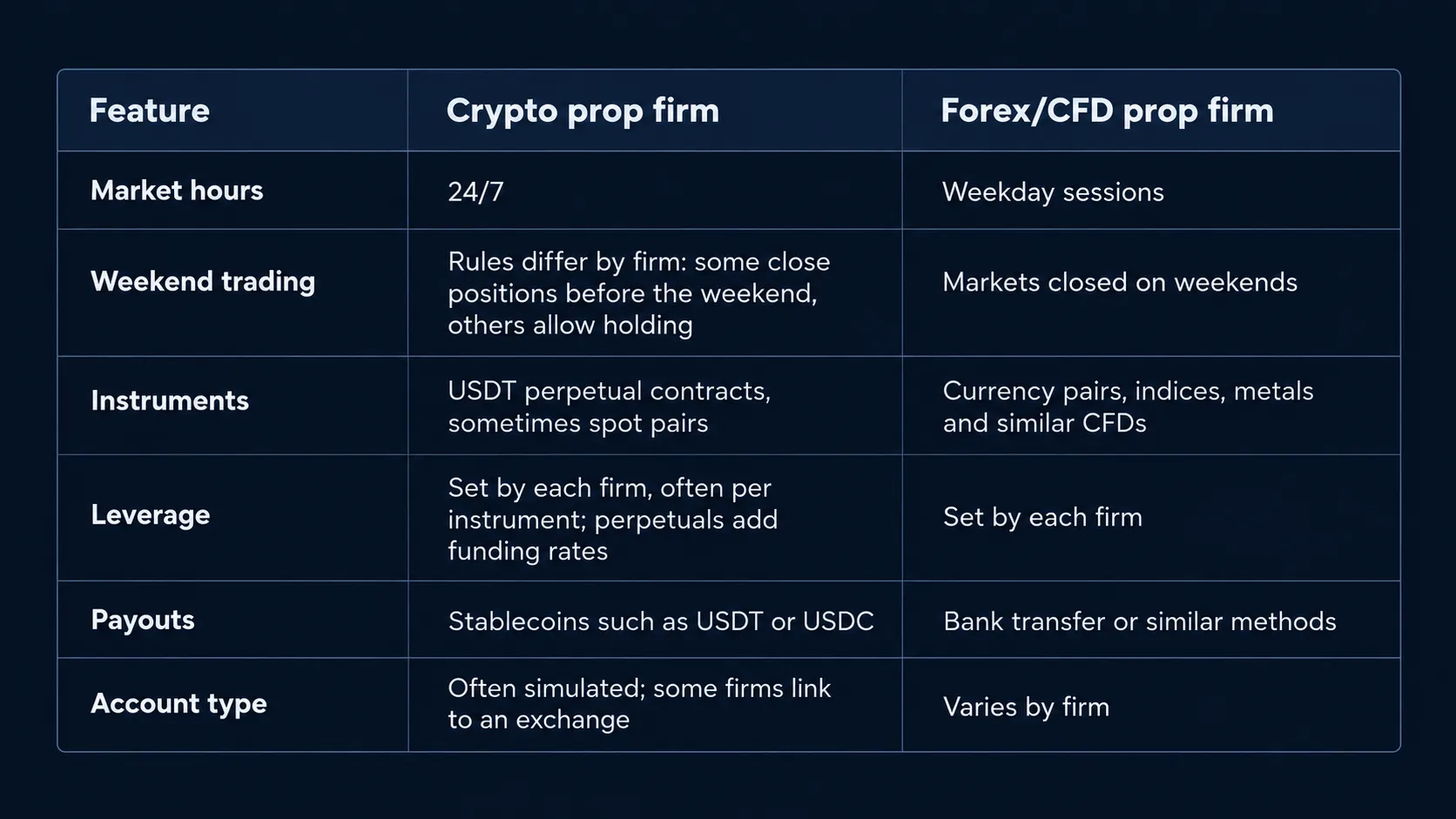
The table shows where a crypto prop firm and a forex or CFD prop firm part ways. Market hours, weekend rules and payout methods differ the most. Leverage and account type depend on the firm in both cases. Use the table as a starting point, then confirm each row in the firm's own rules.
The numbers below are hypothetical. They show how position size, the daily limit and the maximum loss limit interact.
A trader holds a $25K crypto prop firm account. The daily loss limit is 4%, or $1,000. The maximum loss limit is 6%, or $1,500. On Saturday, the trader opens a $50,000 long position, which is twice the account balance.
The market runs 24/7, so the price keeps moving while the trader sleeps. A 2% drop costs $1,000 and breaks the daily limit. A 3% drop costs $1,500 and breaks the maximum limit. By Sunday morning the price falls 5%, and the loss reaches $2,500, or 10% of the account.
A firm may end the account after a breach of either limit, so check the rule for your account type. The daily limit and the maximum limit are separate lines, and the position size decides how fast you reach them.
A $10,000 position would have lost $500 on the same 5% move. That is 2% of the account, inside both limits. Position size, not market direction, set the outcome here.
The trader in this example can still fix the plan. A smaller position, a stop-loss and a weekend exit all keep the loss inside the limits.
Crypto prop firm payouts arrive in stablecoins such as USDT or USDC. Examples from crypto firms show processing times of 12 to 24 hours.
A stablecoin is a crypto token pegged to a currency such as the US dollar. You receive your profit split in a wallet, not as a bank transfer.
Payout cycles differ by firm. Our guide to payout schedules compares on-demand, weekly and bi-weekly models. HyroTrader offers on-demand payouts.
HyroTrader requires at least $100 in profit after the split before you request a payout. It caps each payout at 5% of the initial balance. On a 10,000 USDT account, that cap equals 500 USDT per payout.
The profit split at HyroTrader runs from 80% to 90%. Read the minimum, the cap and the split together to estimate your real payout.
Here is a hypothetical example. A 10,000 USDT account earns 1,000 USDT in profit at an 80% split, which gives you 800 USDT. The 500 USDT cap means you collect that amount in two payouts.
A challenge fee is the price you pay for the evaluation. HyroTrader refunds the fee with your first payout.
Add-ons change the price and the rules of a challenge. Compare the fee, the refund terms and each add-on on the checkout page before you pay.
Write the full cost next to the payout terms. A low fee with a tight payout cap can cost you more time than a higher fee with looser terms.
Check the account type, the written rules and the company behind the firm before you buy. Crypto trading carries a high risk of loss, and a passed evaluation does not promise future payouts. Treat the challenge fee as money you can lose.
Use this checklist for each crypto prop firm:
Sharp moves and thin liquidity can change your fill price. A fill price that differs from the chart can push you closer to a loss limit than you planned.
Crypto prices can move several percent in a day. Size positions so that a normal swing leaves you well inside the daily limit.
Our guide to how to verify a prop firm covers the legal entity step in detail. When you are ready, compare crypto prop firms side by side on PropX Finder.
Compare current crypto challenges in the challenge comparison. Browse live deals on the crypto offers page.


.webp)