
Prop firm payouts follow a fixed cycle that decides how often you can withdraw profit from a funded account. A daily payout prop firm lets you request cash on each trading day.
The money can still take several days to arrive. A prop firm payout schedule has two parts. The first sets how often you can request money. The second sets how long the firm takes to send it.
Below you find six prop firm payout models side by side. You also get the rule for when your first payout clock starts. A short checklist at the end helps you compare firms before you buy a challenge.
A prop firm payout schedule sets how often you can withdraw profit from a funded account. The schedule covers timing alone. Withdrawal methods and account conditions belong to the wider payout process.
You read prop firm payouts through two numbers. The first is the gap between requests, such as 7 or 14 days. The second is the settlement time after the firm approves a request.
A payout moves through three stages: request, approval and settlement. Each stage has its own timing.
You submit the request once your account meets the firm's conditions. The firm then checks your trading against its rules and approves or rejects the request. Settlement is the moment the money reaches your wallet or bank account.
A firm that advertises a daily payout may mean the first stage alone. Ask for the timing of all three stages before you compare any prop firm payout schedule.

The payout clock starts at your first trade on the funded account. The day you pass the challenge does not count. A firm with a 14-day first cycle counts 14 days from that first funded trade.
Data from fxnx.com shows the same pattern and splits the path from pass to paid into five operational stages. First-payout rules differ between firms, so a 14-day label on two sites can describe different start points.
Write down the date of your first funded trade. Count your minimum trading days from that date and compare the result with the firm's stated prop firm payout schedule. The comparison shows when your first request becomes possible.
Firms set a minimum number of trading days and a minimum profit before the first payout. They also ask for identity verification, known as KYC. These conditions differ from firm to firm, so read them on the firm's own page.
A prop firm payout schedule means little if you cannot meet these conditions. For the step-by-step version, read the full payout process.
Prop firm payout schedules fall into six models, from daily requests to monthly cycles. Each model suits a different trading style and cash need. The sections below describe each model and show the yearly payout count.
A daily payout lets you request a withdrawal once per trading day when you meet the firm's conditions. Prop Firm Match notes that daily schedules are rarer than weekly and bi-weekly ones. Some firms set minimum payout amounts.
A daily payout prop firm suits active traders who withdraw small amounts on a regular basis. Settlement can still take several business days. Read the minimum amount before you count on small, frequent withdrawals.
A weekly payout lets you withdraw once every seven days, up to 52 times a year. The short gap helps you lock in profit before a losing streak erases it.
Weekly prop firm payouts give you more control over timing. Each request still goes through the firm's checks, so you file more requests than on a longer cycle.
A 10-day payout lets you withdraw once every 10 days, which adds up to 36 payouts a year. Prop Firm Match counts that as about 30% faster than a bi-weekly cycle with 26 payouts.
The 10-day cycle sits between weekly and bi-weekly prop firm payouts. First-payout rules can differ from later cycles, so read both.
A bi-weekly payout lets you withdraw once every two weeks, or 26 times a year. Prop Firm Match calls it the most common frequency in the industry.
Bi-weekly prop firm payouts give you 26 chances a year to take profit. The longer gap gives your profit more time to shrink before you can touch it.
A monthly payout lets you withdraw once per month, which gives 12 payouts a year. Many CFD and forex firms run 14-day or 30-day cycles. Monthly prop firm payouts suit traders who do not need regular cash flow.
An on-demand payout lets you request a withdrawal whenever you meet the firm's conditions. No fixed calendar applies. Many futures firms use on-demand or weekly payouts, and CME-based accounts settle daily.
Treat this as a tendency and confirm each firm's terms. On-demand prop firm payouts give you the most control over timing. Per-request caps and minimum profit rules set the limits.
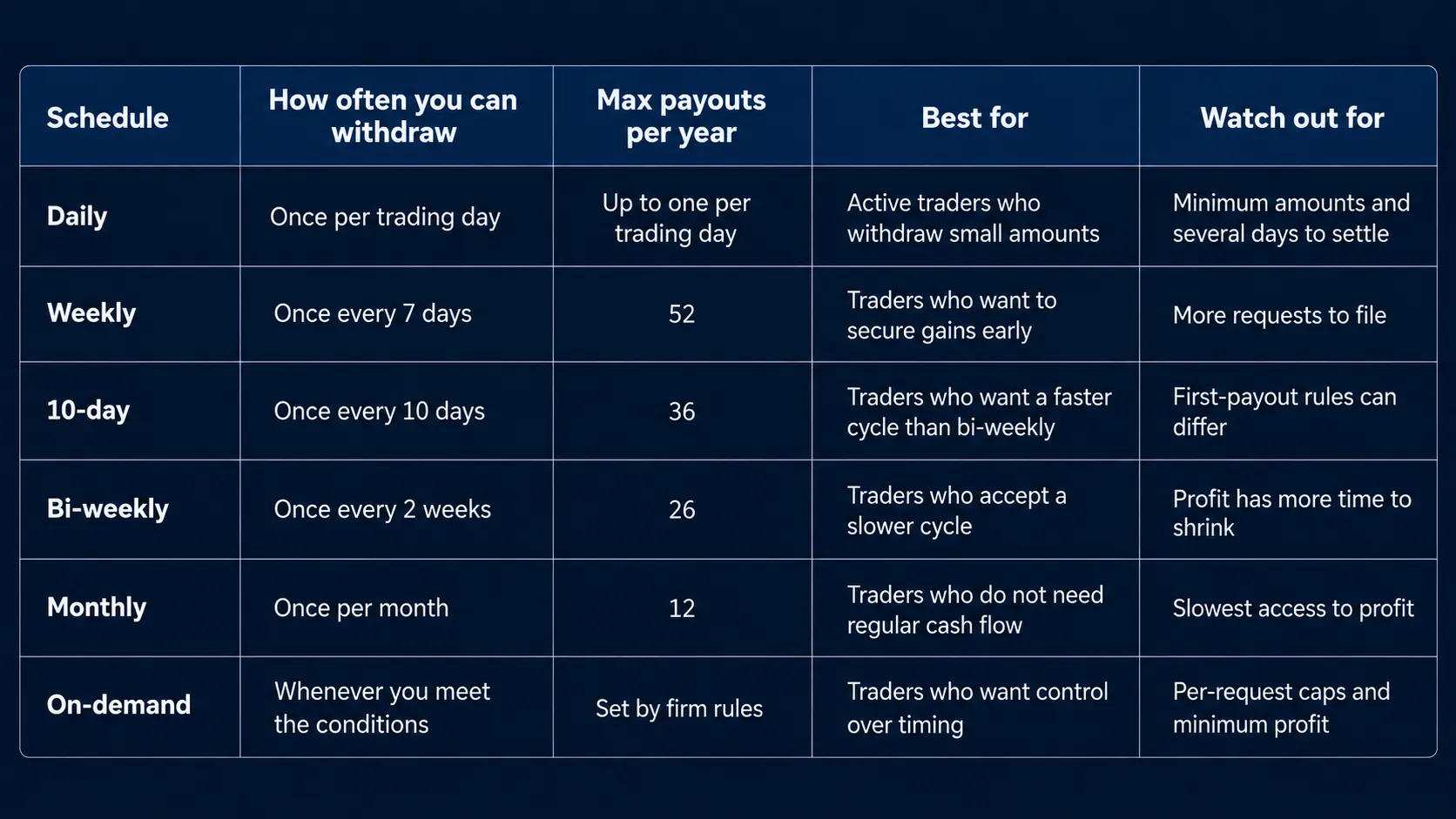
Weekly, 10-day, bi-weekly and monthly cycles give 52, 36, 26 and 12 payouts a year. Daily and on-demand schedules have no fixed count. The firm's rules set their limits.
A daily payout prop firm label promises quick cash, and the details decide whether it delivers. A daily payout means you can request a withdrawal each trading day. The firm still needs time to approve and settle it.
Daily eligibility describes the day you may file a request. Settlement describes the day the money arrives. Firms can take several business days to settle after they approve a request.
Compare both numbers before you treat a daily payout prop firm label as fast cash.
HyroTrader offers on-demand payouts for crypto accounts. Its terms allow the first payout after one day on the funded account. The firm processes requests in 12 to 24 hours.
The same terms require at least $100 in profit after the split. Each payout has a cap of 5% of the starting balance. Payouts go out in USDT or USDC.
The profit split is your share of profit after the firm takes its cut. A cap and a minimum shape your real payout schedule as much as the cycle length does.
Ask the same three questions of every daily payout prop firm:
A daily schedule can come with minimum amounts that block small withdrawals. It can also add checks to each request. A daily firm with slow settlement can pay later than a bi-weekly firm with fast settlement.
Rule breaches, unmet minimums and missing identity checks delay or block prop firm payouts. Five causes cover most cases:
A payout denial after a rule breach differs from a delay. Check a firm's record on both before you buy a challenge. Delays in prop firm payouts cost you time, and denials cost you the profit itself.
Read the rules before your first request. Keep your identity documents ready. Track your trading days against the firm's minimum so the prop firm payout schedule works for you.
Pick a prop firm payout schedule that matches your trading style, your cash needs and the firm's minimum thresholds. Use this checklist when you compare firms:
Futures and forex prop firms follow different payout patterns. Many futures firms offer on-demand or weekly payouts. Many CFD firms use 14-day or 30-day cycles.
Treat these as tendencies and check each firm's terms. Compare two or three firms on the same checklist. Write down the cycle, the settlement time, the minimum and the cap for each one.
The firm with the shortest cycle may not give you the fastest cash once you add the other numbers. Your own trading rhythm decides which prop firm payout schedule fits.
The numbers below are hypothetical. They show how cycle length changes what you can withdraw.
Two traders hold a $50K funded account with a 90% profit split. Both place the same trades on the same days. Their profit grows to $1,500 by day 7. Both then lose $900 by day 11, so profit falls to $600.
Trader A has a 7-day cycle. On day 7, Trader A withdraws $1,350, which is 90% of $1,500.
Trader B has a bi-weekly cycle and waits until day 14. By then Trader B holds $600 in profit and withdraws $540, which is 90% of $600. Trader A withdrew $810 more.
The gap comes from timing. Both traders made the same trades. Trader A took profit at the peak, and Trader B waited through the drop.
A shorter cycle lets you secure profit before you give it back. It also means more requests to file, and the firm applies its checks to each one. The example ignores fees and later trades to keep the numbers simple.
Cycle length leaves your drawdown rules unchanged. Drawdown is the maximum loss the firm lets the account take, and a loss still counts against you.

Compare current challenges and their payout terms in the challenge comparison. Browse live deals on the offers page.


.webp)