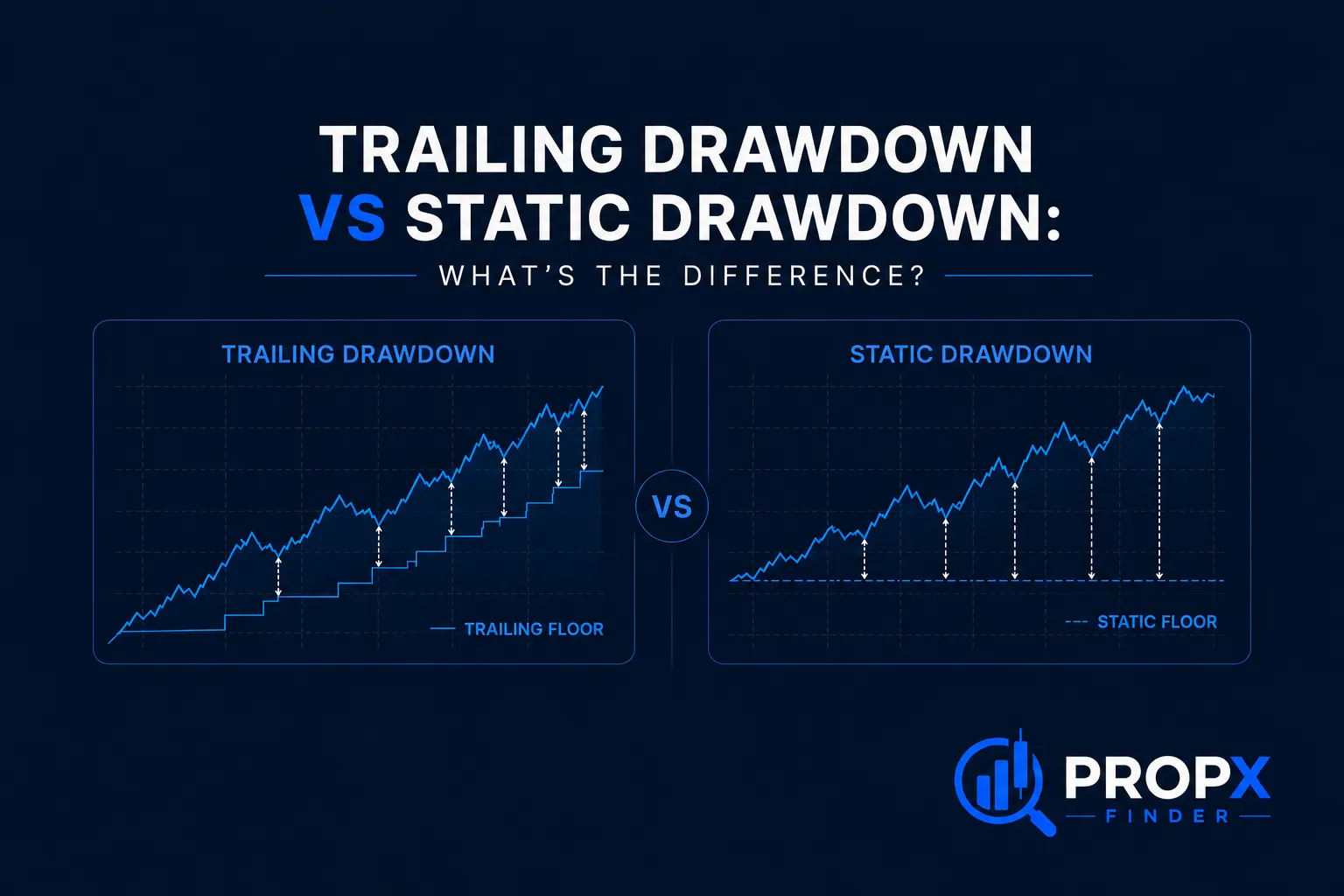

Instant funding gives you a funded account without a testing phase, usually for a higher fee. Evaluation-based funding requires you to pass a challenge first, but costs less to start and often pays a higher long-term split.
Instant funding gives you a funded account without a testing phase, usually for a higher fee. Evaluation-based funding requires you to pass a challenge first, but costs less to start and often pays a higher long-term split. Both models get you trading a firm's capital. The difference sits in what you pay, when you get access, and how much risk room you have once you're live.
Traders new to prop firms often assume instant funding is the "easy" option and evaluation is the "hard" one. That framing misses the real trade-off. This article breaks down both models, shows how three real firms structure them, and gives you a framework to pick the one that fits your budget and trading style.
Instant funding gives you access to a funded trading account immediately, without a testing phase. You pay an upfront fee, pass basic verification, and start trading firm capital the same day.
This speed comes at a cost. Instant funding programs typically charge more than evaluation accounts of the same size. Profit splits also tend to start lower, and drawdown limits run tighter than what you'd get after clearing an evaluation.
Who this fits: traders who want capital fast and can work within stricter risk rules. If you're confident in your strategy and don't want to spend weeks proving it in a challenge, instant funding removes that step.
Example from the market: AquaFunded Futures offers an Instant Standard plan alongside its Beginner, Standard, and Flex evaluation tracks. The instant option skips the challenge phase entirely, trading a lower starting split for immediate access. Compare AquaFunded Futures directly to see current terms.
Evaluation-based funding requires you to hit a profit target and stay within risk rules during a test phase, typically structured as 1-Step or 2-Step. Once you pass, the firm grants a funded account.
The entry cost runs lower than instant funding. You're paying for a challenge attempt, not immediate capital access. In exchange, evaluation accounts usually start with a better profit split and looser drawdown rules once you're funded, since you've already demonstrated risk control during the test.
Who this fits: traders working with a smaller budget or those who want a higher long-term split and are willing to spend time passing the evaluation first.
Example from the market: FXIFY runs a 2-Phase evaluation model with an 80/20 standard split and account sizes up to $400K. You clear both phases before the firm hands you a funded account. See the full structure on the FXIFY challenge page.
Curious how the testing phase itself works? Read What Is a Prop Firm Challenge? How the Evaluation Works for a full breakdown of profit targets and rule structures.
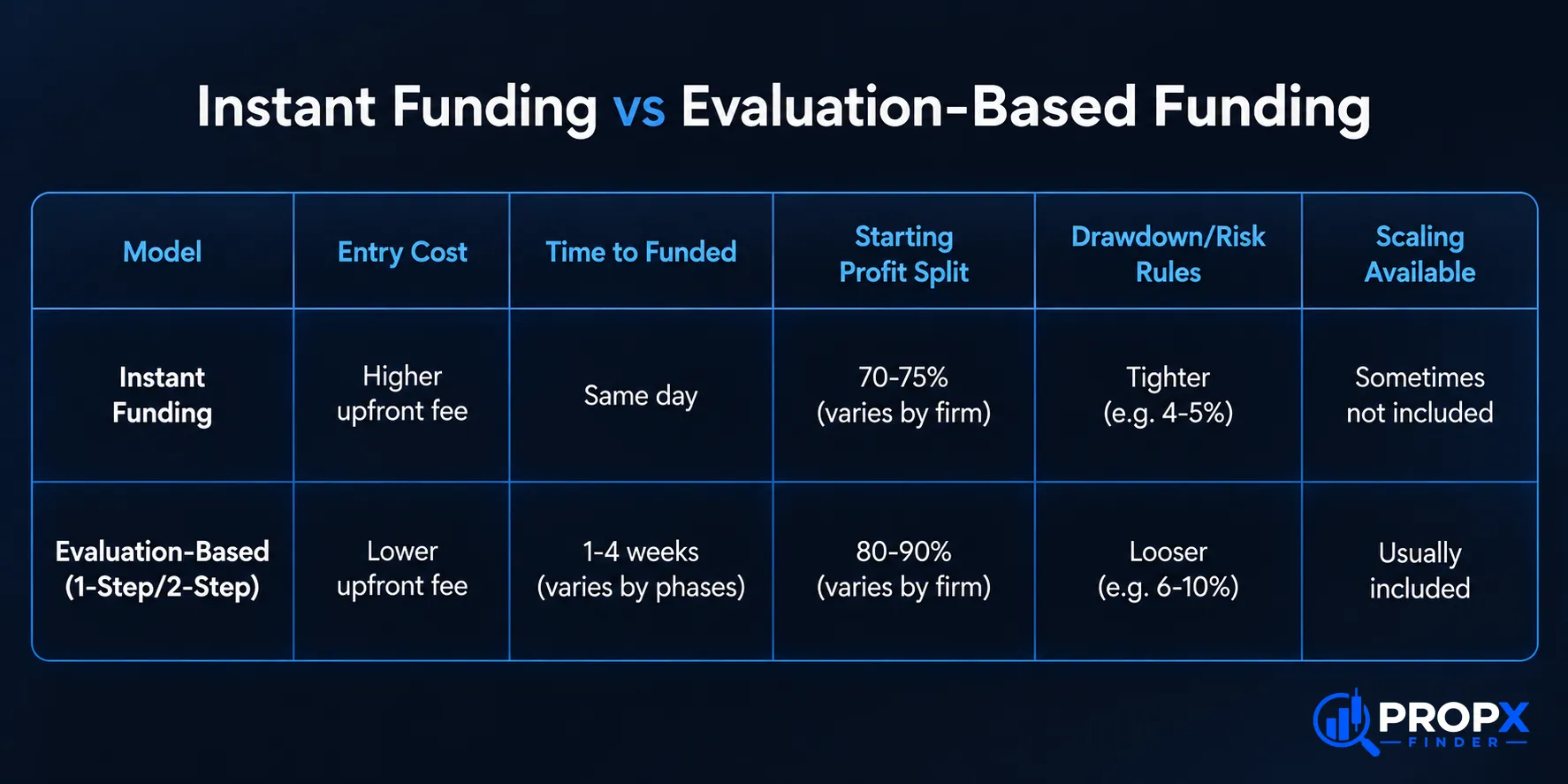
The two models trade speed against cost, and starting split against starting risk room. Instant funding gets you trading sooner but usually at a lower split and tighter drawdown. Evaluation-based funding takes longer but tends to reward you with better terms once you're funded.
Some firms don't force you to pick one path. Mubite, a crypto-only prop firm, offers Instant, 1-Step, and 2-Step options side by side, with profit splits up to 90% and accounts up to $200K depending on the track you choose. Browse Mubite's challenge options to compare all three directly.
Once you're funded under either model, payouts work on similar mechanics: you hit a profit split percentage, request a withdrawal, and the firm processes it on its schedule. For the full mechanics of how that split and payout process works, see How Do Funded Trading Accounts Work? (Profit Split & Payouts Explained).
Start with your budget. If the instant funding fee fits comfortably and you'd rather skip weeks of testing, that upfront cost buys you time. If a smaller entry fee matters more than speed, an evaluation account gets you there for less.
Next, check your drawdown tolerance. Instant funding rules tend to sit tighter, since the firm hasn't seen you trade yet. If you need more breathing room on a bad week, an evaluation account funded after you've proven risk control usually gives you that room.
Finally, think about scaling. Some instant funding programs don't include a scaling plan, while most evaluation-based accounts do once you're funded. If growing your account size over time matters to your strategy, check whether your chosen program includes one. What Is a Prop Firm Scaling Plan? How Account Sizes Grow explains how that growth typically works.
Both traders start with $2,000 to spend on a prop firm account.
Trader A picks instant funding. She pays the full fee upfront and gets a $50K funded account the same day. Her starting profit split sits at 70%, and her max drawdown is capped at 4%. She starts trading immediately but has to manage risk carefully from day one, since there's no room to grow into looser rules until she clears a review period.
Trader B picks a 2-Step evaluation. He pays a lower entry fee for a $50K challenge and spends three weeks clearing both phases. Once funded, his starting split is 80%, and his drawdown allowance sits at 6%. He waited longer to access capital, but starts with a higher split and more room to absorb a losing week.
Neither approach is wrong. Trader A values speed and works within tighter rules. Trader B accepts a delay for better long-term terms. The right choice depends on what you're optimizing for, not which path is objectively better.


.webp)