
A prop firm scaling plan is a rule that gives you more buying power or more capital once you hit a profit target. The term covers three separate mechanics that traders often mix up: contract limits in futures, balance growth in forex and CFD accounts, and a trader's own choice to reinvest payouts.
This article separates all three, with the conditions attached to each.
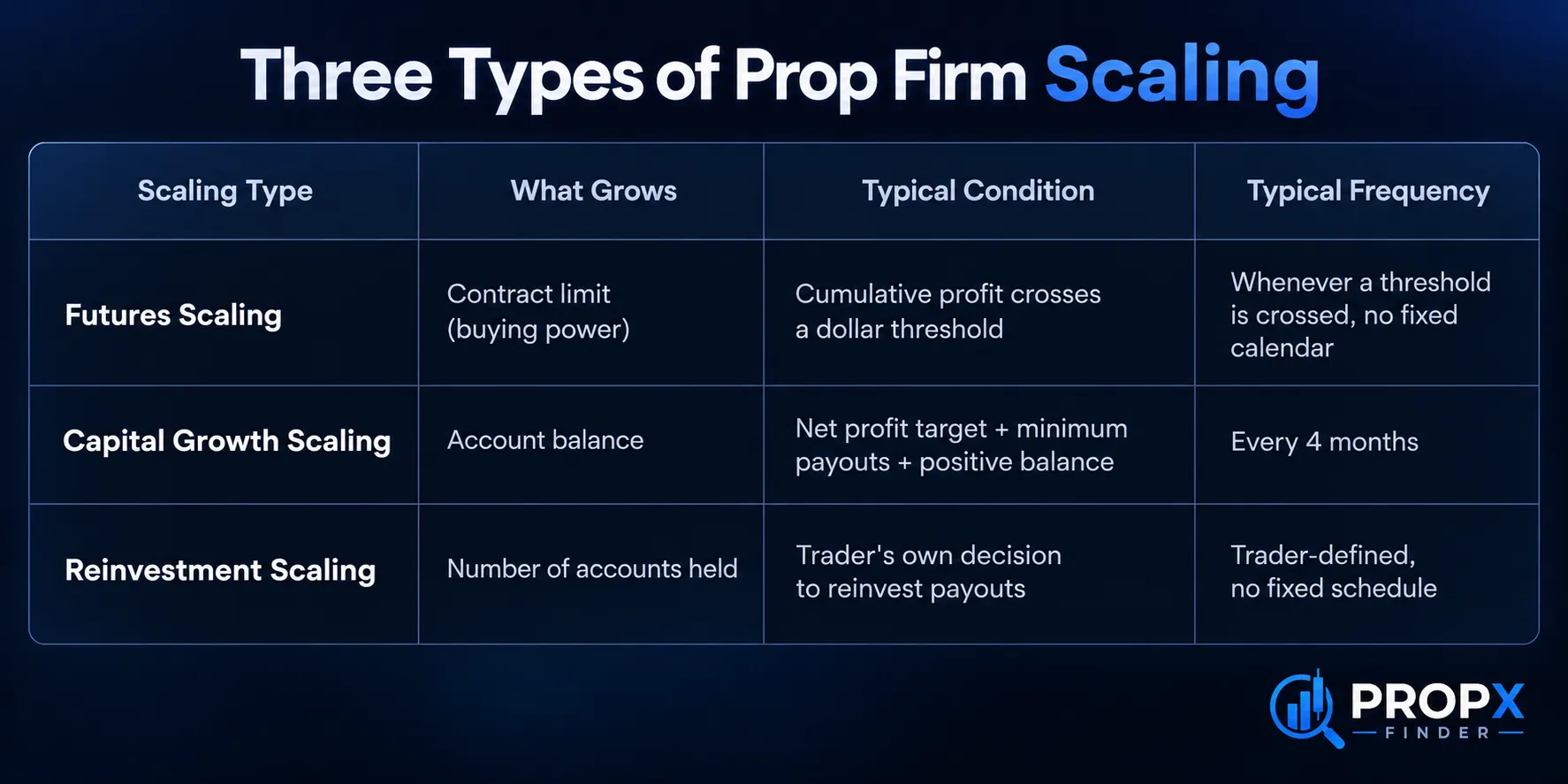
Prop traders use one word, "scaling," for three unrelated mechanics. Two come from firm rules. One comes from a trader's own decision.
This mechanic raises the number of contracts you can hold at once. Your account balance stays flat. Your buying power grows.
This mechanic raises your account balance directly, often alongside a higher profit split. Most forex and CFD firms use this version.
No firm offers this as a rule. You take payouts from one account and use them to buy a new evaluation, building a portfolio of funded accounts over time.
Mix these up and you get the wrong expectations. A futures trader who reads about capital growth scaling expects a bigger balance, then gets confused when only the contract limit moves.
Futures scaling plans raise the number of contracts you can trade, not your account balance. Your limit rises in tiers as your cumulative profit on the account crosses set dollar thresholds, not on any fixed calendar.
A common pattern in the industry: a $50,000 account might start capped at 2 contracts, move to 3 once profit passes $1,500, then unlock 5 contracts past $2,000. The new tier often applies from the next trading session, not the instant you cross the line. Profit that drops back below a threshold, for example after a payout, can pull your limit back down to the previous tier. The mechanic tracks your cumulative profit, not the calendar.
Futures contracts carry fixed tick values, so a firm managing risk through contract count matches how futures margin actually works. A firm can't scale your "balance" the same way, because your balance was never the constraint in the first place.
Capital growth scaling plans raise your account balance after you clear a profit and time requirement, sometimes paired with a higher profit split. When people picture a "scaling plan," this is usually what they mean.
A typical structure: after a four-month cycle, a trader who reaches at least 10% net profit, completes a minimum number of payouts, and holds a positive balance qualifies for a 25% increase to their account size. Some firms pair this with a profit split bump, moving from 80% to 90% on certain account types. Growth usually caps at a maximum account size, often in the low millions.
This version shows up mainly at forex and CFD firms, where the firm's own capital backs your balance directly. Futures firms work through contract-based limits instead, for the reasons above.
This version has nothing to do with any firm's rulebook. You take a payout and use it to fund a second evaluation, either with the same firm or a different one. Do this a few times and you end up running a portfolio of separate funded accounts side by side.
The strategy carries its own tradeoffs around risk and account management, which go beyond a plain overview of what scaling means. Hold onto the core distinction: reinvestment is your call, not something a firm hands you.
Maria trades a $50,000 forex evaluation account. Her firm runs a capital growth plan: four months in, having hit her profit target and completed two payouts, her balance grows by 25% and her profit split moves from 80% to 90%. She keeps trading the same account, now with more capital and a better split.
David trades a similar account at a different firm. He skips the wait for his firm's growth cycle. Instead, he takes his first payout and buys a second $50,000 evaluation. Six months in, he holds two funded accounts running in parallel, each under its own rules.
Both traders scaled. Maria's account grew inside one firm's system. David built a second account through his own choice to reinvest. Nothing stops a trader from doing both.
Ready to compare prop firms by their actual growth mechanics instead of marketing claims? Explore PropX Finder
Not sure which account type fits your trading style? Explore PropX Finder


.webp)