
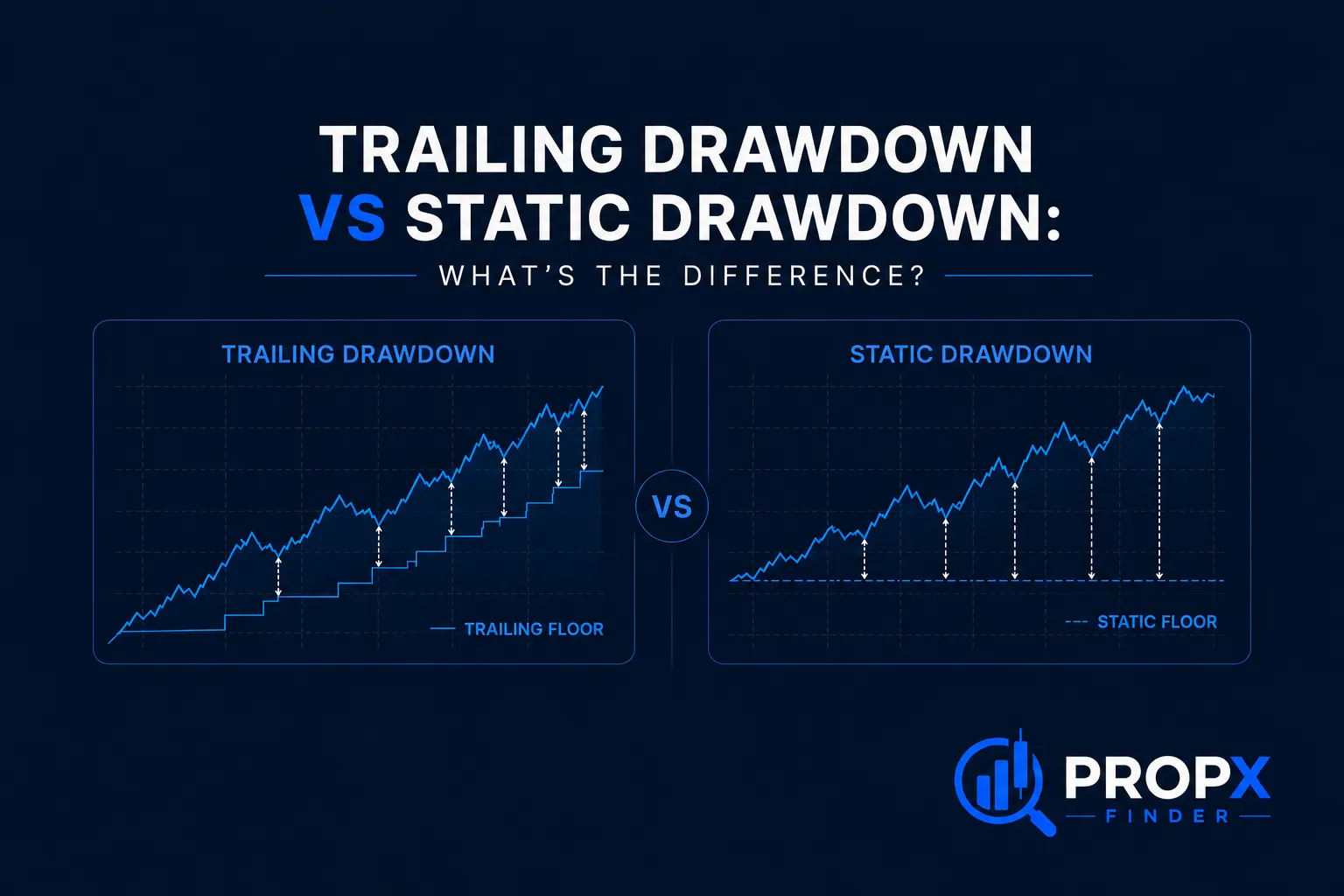
Static drawdown sets a floor that never moves. Trailing drawdown sets a floor that rises as your account grows, sometimes even before you close a trade.
That confusion costs traders accounts. You see a green day, feel safe, and don't realize your floor climbed right along with your equity. Or you pick a firm with an intraday trailing model when your scalping style needs a static one. This guide breaks down both mechanics. Then it digs into the five trailing drawdown variants firms use today: end-of-day, real-time, balance-based, equity-based, and lock-to-static. You'll also see which axis of measurement, balance or equity, determines how aggressive your floor is. And which drawdown type fits your trading style.
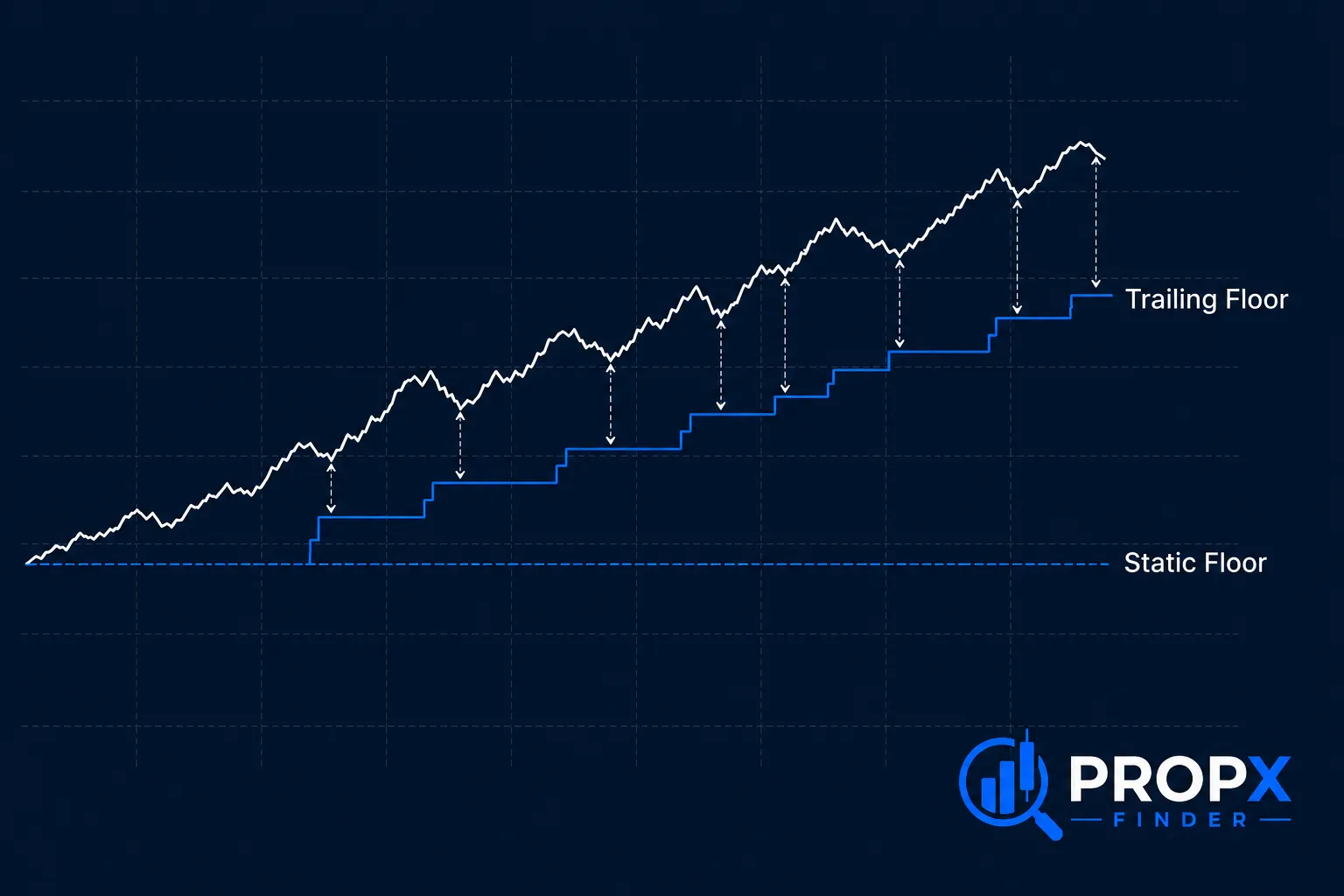
Drawdown is the drop from your account's peak value to its current value, measured in dollars or percent. Cross the firm's maximum drawdown limit and your evaluation ends, funded or not.
Every prop firm caps how much you can lose before they cut you off. That cap is your drawdown limit. Hit it once, and the account closes. This isn't a soft warning. It's a hard line, and firms enforce it automatically through their trading platform.
The type of drawdown a firm uses changes your entire risk strategy, not just the numbers on a dashboard. A static floor lets you plan around a fixed worst case. A trailing floor moves the target while you're aiming at it. You need to know which one you're trading against before you place a single trade. The same account size and dollar limit can mean two completely different risk profiles, depending on the mechanic behind them.
For the fuller picture of how this fits into the evaluation process, see our guide on prop firm challenges.
Static drawdown sets your loss limit at a fixed dollar amount below your starting balance, and that floor stays put no matter how much you profit.
Say you start a $100,000 account with a 10% static drawdown. Your floor sits at $90,000 on day one. Six months later, after banking $30,000 in profit, your floor is still $90,000. Profit builds a cushion. It never raises the bar you have to clear to stay alive.
This model suits traders who compound gains slowly and hold positions across multiple days. Swing traders benefit most. A static floor doesn't punish a big overnight equity swing on an open position, unlike some trailing models. According to fortraders.com, several established firms lean toward static drawdown specifically because it rewards consistent, patient trading over rapid scaling.
The tradeoff: static drawdown gives you less breathing room early on, before profit builds your buffer. A string of losing days near the start hits that same fixed floor. So does a seasoned trader six months in.
Trailing drawdown moves your floor upward as your account value rises, and five distinct variants exist, each with a different trigger for when and how that floor climbs.
Most traders think "trailing drawdown" describes one mechanic. It doesn't. The differences between these five types can mean thousands of dollars in usable risk buffer on the same account size.
End-of-day trailing recalculates your floor once per day, at market close, based on your closing balance. Intraday swings don't touch it.
Say your account starts at $50,000 with a $2,500 trailing drawdown. You open the day at $50,000, spike to $54,000 by midday, then close the day at $51,200. Your floor recalculates based on that $51,200 close, moving to $48,700. What happened during the day, including that $54,000 peak, doesn't matter. Only the closing number counts.
Tradeify uses this model, according to tradesviz.com. It gives day traders more freedom to ride volatility mid-session without worrying about a floor that's tracking every tick.
Real-time trailing recalculates your floor continuously, tracking your equity as it moves throughout the session, including unrealized profit and loss on open positions.
This is the strictest version. Your floor doesn't wait for you to close a trade or for the day to end. Your equity climbs to a new peak at 10:47am, and your floor climbs with it immediately. It stays there even if you give back those gains an hour later.
Apex Trader Funding runs this model, per damnpropfirms.com. It demands active headroom management all session long. A strong open followed by a pullback can leave you with far less cushion than the day's raw profit-and-loss suggests.
Balance-based trailing only recalculates your floor when you close a trade. Open positions, no matter how profitable, don't move the floor until you realize that profit.
Picture a $25,000 account with a $1,250 trailing drawdown, floor starting at $23,750. You open a trade that's up $600 unrealized. Your floor stays at $23,750 until you close that trade. Once it closes and locks in the $600, your floor rises to match your new balance.
This model rewards patience with open positions. You can let a trade run without your safety margin shrinking in real time.
Equity-based trailing recalculates your floor using live equity, meaning unrealized gains on open positions raise your floor immediately, before you ever click "close."
This creates a counterintuitive trap. A trade moves in your favor, your floor rises to match it, then the trade pulls back before you exit. You're left with less room than before the trade existed. The position was profitable the whole time. Traders holding runners through equity-based trailing accounts need to watch floor movement as closely as the trade itself.
Lock-to-static trailing behaves like standard trailing drawdown until your account reaches a specific milestone, usually your starting balance. At that point, the floor stops moving and locks in place permanently.
Topstep's funded accounts use this approach, according to propjournal.net and traderssecondbrain.com. Picture a $50,000 account with a $2,000 trailing drawdown, floor starting at $48,000. As your balance climbs toward $50,000, the floor trails right along with it. The moment your balance hits that $50,000 breakeven mark, the floor locks there for good. Keep trading past that point, and further profit no longer raises your floor. You've converted a moving target into a fixed one.
This hybrid gives you trailing risk early, when the firm wants proof you can survive drawdown pressure. Then it gives you static protection once you've held a profitable balance.
Drawdown mechanics split across two separate axes. One is what gets measured: balance or equity. The other is how the floor moves: static, trailing, or end-of-day trailing. Firms mix and match both.
Balance-based drawdown only counts money from closed trades. Equity-based drawdown counts your account value in real time, including open positions. This axis determines whether an unrealized gain or loss can move your floor before you act on it.
This axis determines when the floor recalculates: never (static), constantly (real-time trailing), or once per day (end-of-day trailing).
A firm's drawdown model isn't always one clean label. Some firms measure balance only, but recalculate that floor once per day like an end-of-day trailing model. Others tie a live equity reading to a floor that never resets, blending a trailing feel with a static ceiling. That kind of combination can hide your real cushion. Open positions might not count toward the floor, even while the floor keeps climbing on a schedule. Read a firm's rules assuming both axes apply separately, or you'll misjudge how much protection you have.
The table below breaks down all six models side by side: what each one measures, when the floor moves, and how difficult it is to manage.
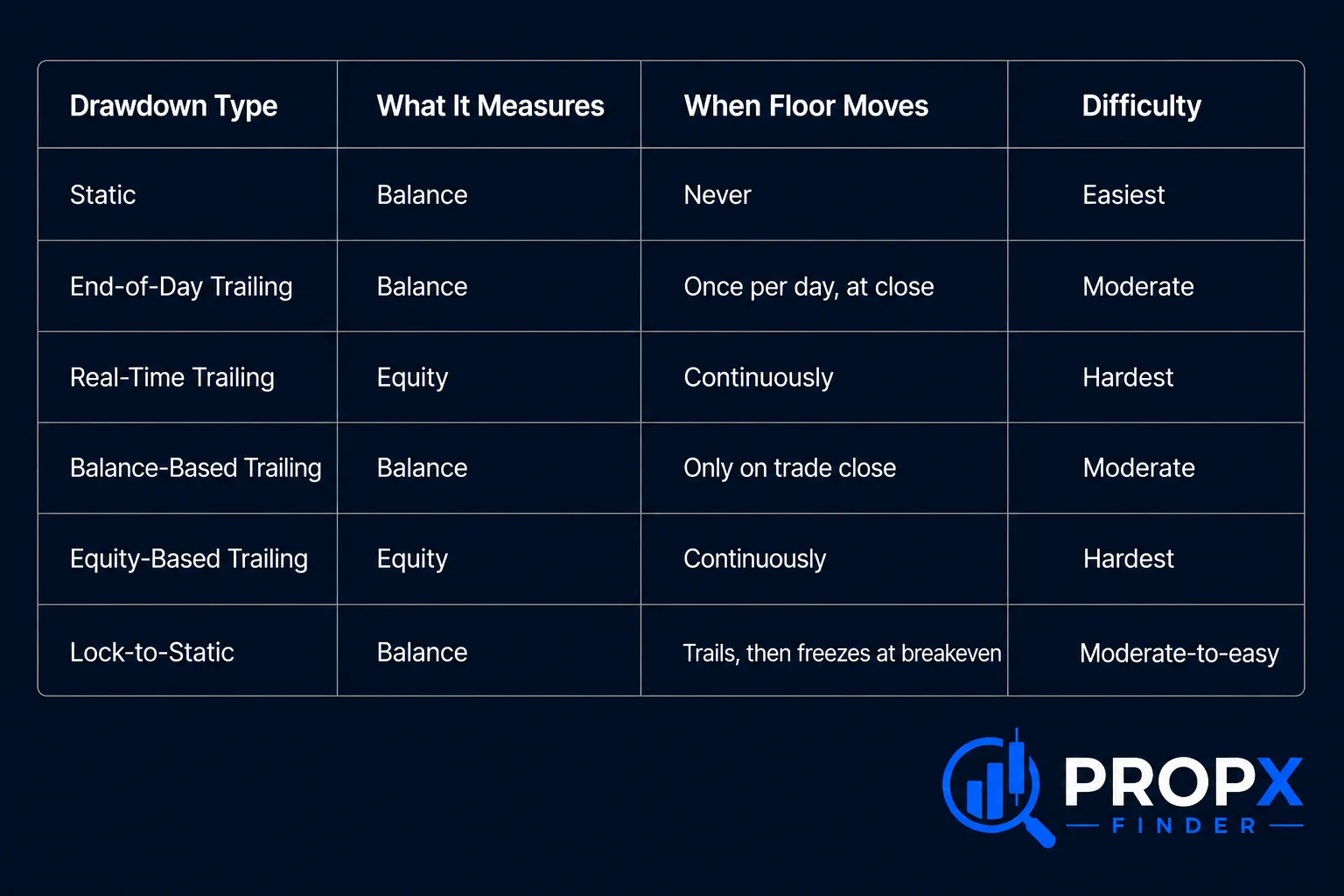
Scalpers and day traders who close positions fast tend to do well under balance-based or end-of-day models. Intraday noise doesn't threaten their floor. Swing traders holding overnight often prefer static drawdown. A multi-day equity swing on an open position can't shrink their buffer. Anyone trading equity-based or real-time trailing accounts needs to track floor position as its own metric. Check it constantly, not just at session's end.
You're trading a $50,000 account with a $2,500 real-time trailing drawdown. Floor starts at $47,500. Midway through the session, your equity peaks at $55,600 on an open position running well. Your floor immediately climbs to $53,100, tracking that peak in real time.
The trade pulls back before you close it. You end the day up $5,100 net, closing at $55,100. Your floor, locked in at that $53,100 peak, sits at $53,100. You still have headroom, but only $2,000 of it, despite the strong day.
A trader running that same session under an end-of-day trailing model would carry more room. Only the closing balance counts there, putting their floor at $52,600 and leaving $2,500 of headroom instead. The equity peak, not the realized profit, is what shrank the buffer. That's the gap between "feeling good about a trade" and knowing your real risk exposure in the moment.
Ready to compare drawdown rules across firms side by side? Explore PropX Finder to see risk models, payout terms, and entry costs in one place.



.webp)