
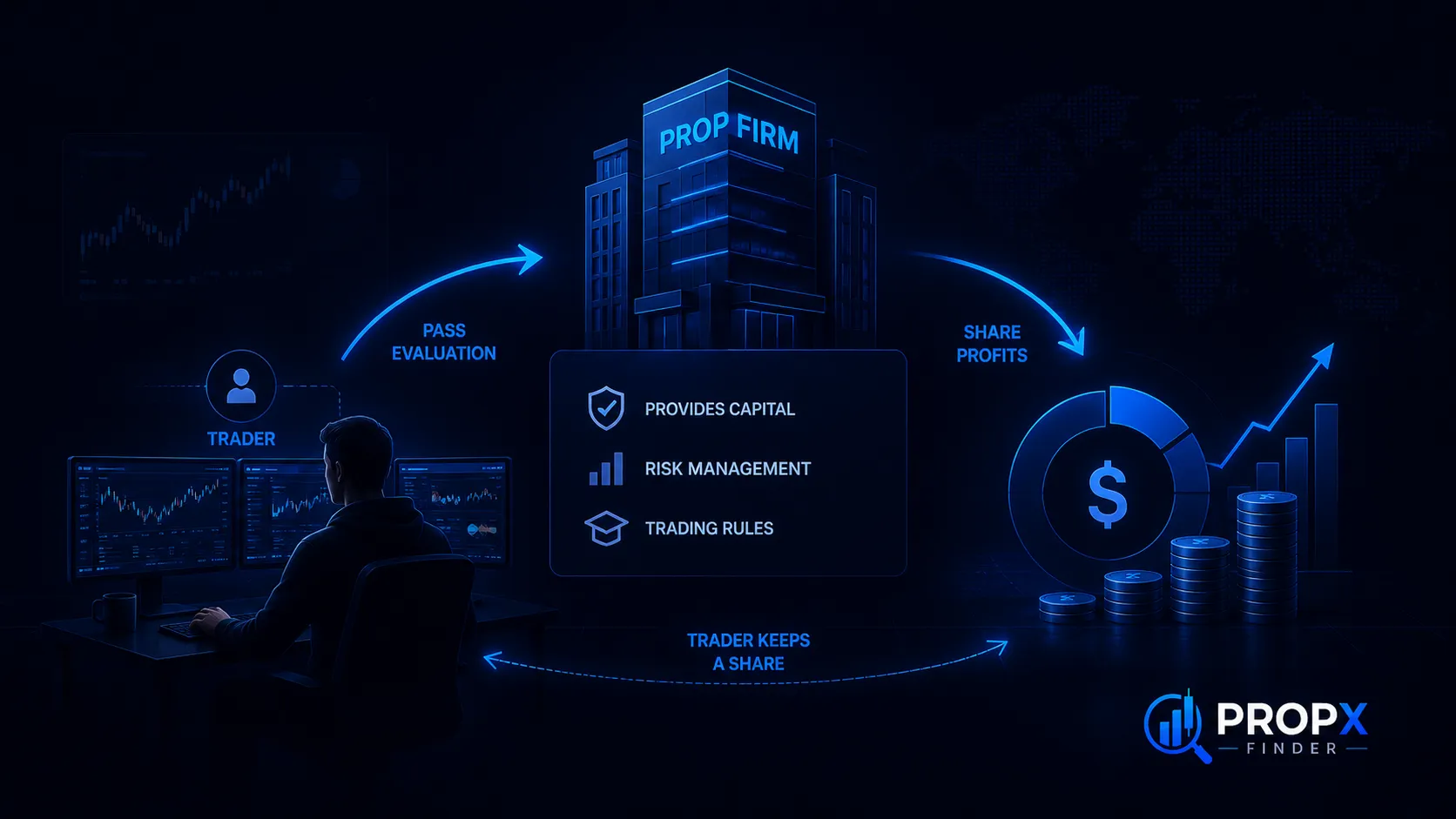
A prop firm gives traders capital to trade in financial markets in exchange for a share of the profits. Instead of risking your own money, you trade the firm's funds after proving your skills through an evaluation process.
This article breaks down what a prop firm is, how these firms make money, the different types you'll come across, and how to get started.
A prop firm is a company that funds traders with its own capital instead of client or investor money, in exchange for a cut of the profits those traders generate. The term comes from "proprietary trading" - trading with the firm's own money rather than on behalf of outside clients.
Proprietary trading itself isn't new. Banks and hedge funds have run in-house trading desks for decades, employing professional traders to generate returns using the institution's own balance sheet. What's changed in the last several years is the rise of the retail prop firm model: instead of hiring traders as employees, these firms let anyone apply by passing a paid evaluation, often called a "challenge."
Institutional prop desks (inside banks or hedge funds) hire experienced traders directly, provide salaries, and keep trading strategies proprietary to the firm. Retail prop firms flip this: anyone can apply, funding is earned through a skills-based evaluation rather than a hiring process, and traders typically work independently rather than as employees.
Retail prop firms attract a mix of traders. Part-time traders use them to access larger capital than their personal accounts allow. Experienced traders use funded accounts to diversify risk across multiple firms rather than concentrating everything in one personal account. Newer traders use the evaluation process itself as a structured way to prove - to themselves as much as anyone - that their strategy works under real rules.
Pro firms primarily make money from evaluation fees, not from the trading profits of the traders who pass. Every trader who buys a challenge pays an upfront fee, and most of them never pass it.
This is the part of the business model that's easy to misunderstand. It can look like firms are designed to fail traders on purpose, but the reality is more specific: firms build strict risk rules because their downside comes from paying out real capital to funded traders, so they need those traders to demonstrate genuine risk discipline before getting access. Evaluation fees fund the firm's operations and offset the capital it eventually allocates to the traders who do pass.
The numbers make the model clearer. According to QuantVPS, only about 5-10% of traders pass a prop firm evaluation on their first attempt. But passing isn't the same as getting paid: only around 7% of everyone who ever buys a challenge goes on to see an actual payout, since some traders who pass still fail to maintain the funded account's rules afterward. And most evaluation failures aren't traders missing their profit target - they're traders breaking a loss limit before they get there. That pattern is telling: firms aren't setting profit goals out of reach, they're filtering for traders who manage risk consistently, which is exactly the behavior that protects the firm's capital once it's on the line.
Once a trader passes and starts trading the firm's capital, standard profit splits apply - commonly in the 70-90% range in the trader's favor, depending on the firm and account type. For the full breakdown of how funded accounts, drawdown rules, and profit splits work day to day, see What Is a Funded Trading Account?
Prop firms differ along two main lines: what markets they let you trade, and how you get funded.
Most retail prop firms specialize in one or more of the following: futures, forex, and crypto. Some firms support multiple asset classes under one evaluation, while others focus exclusively on a single market. None of these is inherently "better" - the right fit depends on which markets your strategy is built around.
Two main models dominate the space. Challenge-based firms require you to pass a paid evaluation with specific profit targets and loss limits before you get a funded account. Instant funding firms skip the evaluation and give you a funded account immediately, usually for a higher upfront fee and with more conservative limits. These models also handle drawdown rules and payouts differently once you're funded.
Getting started with a prop firm follows a consistent sequence across most providers, even though the specific rules vary firm to firm.
First, choose a firm that supports your preferred asset class and trading style, and compare account sizes, fees, and rules. Second, complete the evaluation (or pay for instant funding, if you choose that model) by trading within the firm's profit target and risk limits. Third, once you pass, you receive a funded account and start trading the firm's capital under its ongoing rules, earning a share of any profits you generate.
That third step is where most of the day-to-day complexity lives - drawdown types, payout schedules, and consistency rules all come into play once you're funded.
What Is a Funded Trading Account?
Ready to compare prop firms side by side? Visit PropX Finder to find a firm that matches your trading style and goals.



.webp)